
No Downtime Deployments with Docker Compose
Modern applications require constant availability, but traditional deployments often involve dreaded outage windows and “Maintenance Mode” pages.
Docker Compose, while simplifying multi-container applications, defaults to stopping existing containers before starting new ones, causing brief downtime.
The goal is to achieve zero-downtime deployment (ZDD), even with a single-server Docker Compose setup, transforming applications into continuously available services.
II. Historical Context of Deployments
- Pre-Container Era (e.g., 2012): Deployments were often manual, scheduled, and involved accepted downtime.
- Docker’s Impact (circa March 2013 onwards): Docker revolutionized deployments by simplifying CI/CD pipelines and enabling immutable infrastructure, leading to consistency across environments and laying groundwork for continuous uptime.
- “DIY Era” of ZDD with Docker Compose: Early ZDD efforts involved complex manual scripting, manipulating reverse proxies (like Nginx), and orchestrating the delicate ballet of old and new containers. This required significant skill and patience.
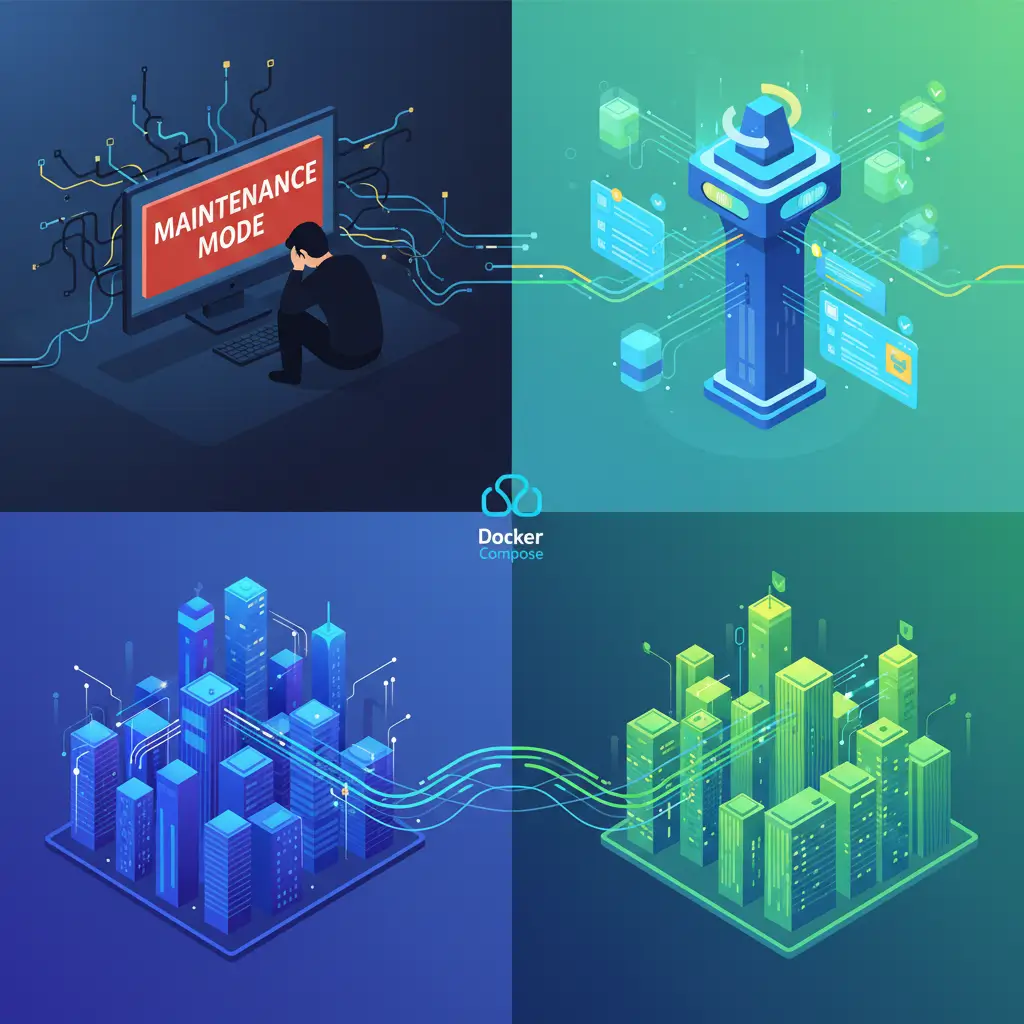
III. Battle-Tested Strategies for Zero-Downtime Deployments
A. Blue/Green Deployment
- Concept: Maintain two identical production environments (“Blue” and “Green”). One is live (“Blue”), while the other (“Green”) stages and tests the new version.
- Process: Deploy and validate the new version to “Green.” Then, instantly switch all incoming traffic from “Blue” to “Green” via a reverse proxy or load balancer. “Blue” becomes the rollback option or awaits its own update.
- Advantages: True zero downtime (instant traffic switch), immediate rollback capability, reduced deployment risk due to isolated testing.
- Disadvantages: Resource-heavy (doubles infrastructure costs), significant challenges in managing database synchronization and data integrity for stateful services.
B. Rolling Updates
- Concept: Gradually replace instances of old containers with new ones, ensuring a sufficient number of active instances remain to handle traffic throughout the deployment.
- Process: Start new containers alongside old ones. Once healthy, gracefully shut down old containers. Repeat until all old instances are replaced.
- Advantages: Less resource-intensive than Blue/Green (requires only a small amount of additional capacity), limits the “blast radius” of bugs (affects only a small percentage of users), allows for early detection and mitigation.
- Disadvantages: Requires strict backward compatibility (old and new versions must run concurrently), can pose version management challenges (database consistency, feature compatibility), users might briefly encounter different versions, rollback can be slower than Blue/Green.
C. The Role of Reverse Proxies (Nginx, Traefik, Caddy)
- Function: Act as traffic directors, routing incoming requests to healthy, active containers.
- Importance: Essential for any robust ZDD strategy.
- Mechanism: Dynamically adapt configurations during deployments, instantly redirecting traffic in Blue/Green switches, and ensuring traffic is only directed to healthy instances in rolling updates. They rely on robust health checks.
D. docker-rollout Plugin
- Purpose: An open-source Docker CLI plugin that automates rolling updates for Docker Compose setups.
- Process: Replaces manual scripting with a single command (
docker rollout <service>). It scales up new instances, waits for health checks to pass, redirects traffic via the reverse proxy, and then retires old containers. - Benefit: Simplifies the complex sequence of actions for rolling updates, leveraging existing Docker health checks.
IV. Controversies and Gotchas
A. “True” Zero Downtime Debate
- Some argue that absolute zero downtime is an elusive myth in complex systems.
- They advocate for “high availability” (e.g., 99.9% uptime) as a more pragmatic goal, focusing on minimizing downtime rather than achieving an impossible ideal.
B. The Kubernetes Question
- Docker Compose Sufficiency: Excels at local development and single-host deployments but may require external tools for robust ZDD.
- Kubernetes/Docker Swarm: Offer native, robust ZDD features, self-healing, and sophisticated traffic management at scale but introduce significant operational overhead and complexity.
- Docker Swarm: Provides native rolling updates with configurable
update_delayandupdate_parallelismindocker-compose.ymlwhen running in Swarm mode. - Decision Factors: Scale, complexity, and availability requirements.
C. Stateful Services (Databases, Caches)
- Challenge: Updating stateful services is significantly more challenging than stateless ones due to data persistence.
- Risks: Losing transient information (user sessions, cached files), maintaining data consistency across versions, potential for data corruption.
- Requirements: Backward-compatible database migrations, replication, redundancy, and robust recovery mechanisms are paramount.
D. Database Migrations as Bottlenecks
- Challenges: Unexpected table locks, data integrity issues, schema changes without disrupting users.
- ZDD Approach: Multi-phased approach, unwavering commitment to backward compatibility, breaking down complex migrations into smaller steps, using database-specific tools for online schema changes, and rigorous testing in production-mirroring staging environments.
E. Networking Niggles
- Reverse Proxy Configuration: Crucial for dynamically updating rules to route traffic to new, healthy containers and gracefully disconnect from old ones.
- Health Checks: Vital signals for the reverse proxy to determine container readiness.
- Graceful Shutdowns: Designing old containers to finish processing ongoing requests before terminating to prevent dropped connections.
- Container Draining: A technique to signal the proxy to stop sending new requests to old containers while allowing them to finish existing ones before shutdown.
V. Future Trends for Docker Compose and ZDD
A. Enhanced Dev Experience
Docker Compose will continue to evolve for local development and testing, becoming more intuitive and integrated with modern workflows.
B. AI/ML Integration
Docker Compose will be crucial for defining and running AI-powered agents, data pipelines, and machine learning models, simplifying the deployment of intelligent systems.
C. Improved Security
The Docker ecosystem’s security advancements (vulnerability scanning, secure supply chains, container isolation) will indirectly bolster the robustness and trustworthiness of Docker Compose deployments.
D. Hybrid & Multi-Cloud Flexibility
Docker Compose’s portable service definitions are well-suited for hybrid and multi-cloud architectures, enabling seamless deployment across different environments and preventing vendor lock-in.
E. Orchestrators Remain Dominant for Scale
- For large, complex, and mission-critical systems, dedicated orchestrators like Kubernetes and Docker Swarm will remain the primary solutions for robust, high-scale ZDD.
- Docker Compose will continue to serve as an entry point and prototyping tool, with configurations often adaptable for larger orchestrators.
VI. Conclusion
- The default
docker compose up -dcommand introduces downtime, but it is avoidable. - Achieving zero-downtime deployments with Docker Compose is possible through:
- Blue/Green Deployments: Robust but resource-intensive.
- Rolling Updates: Incremental and efficient, especially with tools like
docker-rollout. - Reverse Proxies: Indispensable for traffic management.
- Meticulous Planning: For stateful services and database migrations.
- Investing in architectural foresight and tooling leads to improved user satisfaction and developer confidence.
- The digital world awaits uninterrupted application brilliance.


