What Is a Provably Fair Algorithm? The 2026 Guide
For most of online gambling’s history, players operated on faith. You placed your bet, the server rolled its virtual dice, and you received a result. Whether that result was genuinely random or subtly tilted in ways beyond the already-disclosed house edge — you had no way to know. The casino said it was fair. A third-party auditor occasionally agreed. You believed them or you didn’t, and either way, you kept playing.
That arrangement has always been structurally uncomfortable, and in a $100 billion-plus global industry, the stakes of misplaced trust are substantial. Provably fair algorithms emerged as a cryptographic answer to this problem — not a trust-based assurance, but a mathematical proof. Instead of asking players to believe an outcome was fair, these systems let players verify it themselves, independently, after every single round.
The concept originated in Bitcoin gambling circles around 2012, looked like a niche technical curiosity for several years, and has since grown into a foundational standard across crypto gambling, blockchain gaming, NFT mints, and even scientific research. In 2026, with zero-knowledge proofs entering the picture and regulators in Malta, Gibraltar, and the Isle of Man formally incorporating these mechanisms into compliance frameworks, provably fair is no longer experimental. It is, increasingly, the floor.
What Is a Provably Fair Algorithm?
A provably fair algorithm is a cryptographic commitment scheme that allows any participant to independently verify that a game outcome was determined before the round began and was not altered afterward. The operator cannot retroactively change the result. The player can check the math themselves. No trust in the institution is required beyond trusting the cryptographic primitives — which are publicly documented and independently validated by mathematicians and security researchers.
Three components combine to produce every outcome:
- Server Seed — A random value generated by the platform’s server before play begins. The server commits to this value by publishing its cryptographic hash. The actual seed remains secret until after the round.
- Client Seed — A value generated or chosen by the user. This ensures the player has direct input into the outcome, preventing the server from pre-computing results targeted at a specific player.
- Nonce — An incrementing counter that changes with each round, ensuring that even identical seeds produce unique outcomes across successive bets.
These three inputs feed into a hash function to deterministically produce the game result:
hash(server_seed + client_seed + nonce) → game outcome
The dominant implementation uses HMAC-SHA256, treating the server seed as the key and the client seed concatenated with the nonce as the message. The resulting hash is a fixed-length string that gets mapped to a game result — a dice roll, a card draw, a crash multiplier.
One clarification worth stating plainly: provably fair guarantees that the outcome was not manipulated. It does not guarantee favorable odds. The house edge is built into how hash outputs map to game results, and that edge remains entirely intact. A platform can be perfectly, mathematically provably fair and still return 1% or 5% to the house on every bet. These are separate questions, and conflating them — which some marketing does, deliberately or carelessly — is a meaningful misrepresentation.
How the Cryptographic Verification Process Works
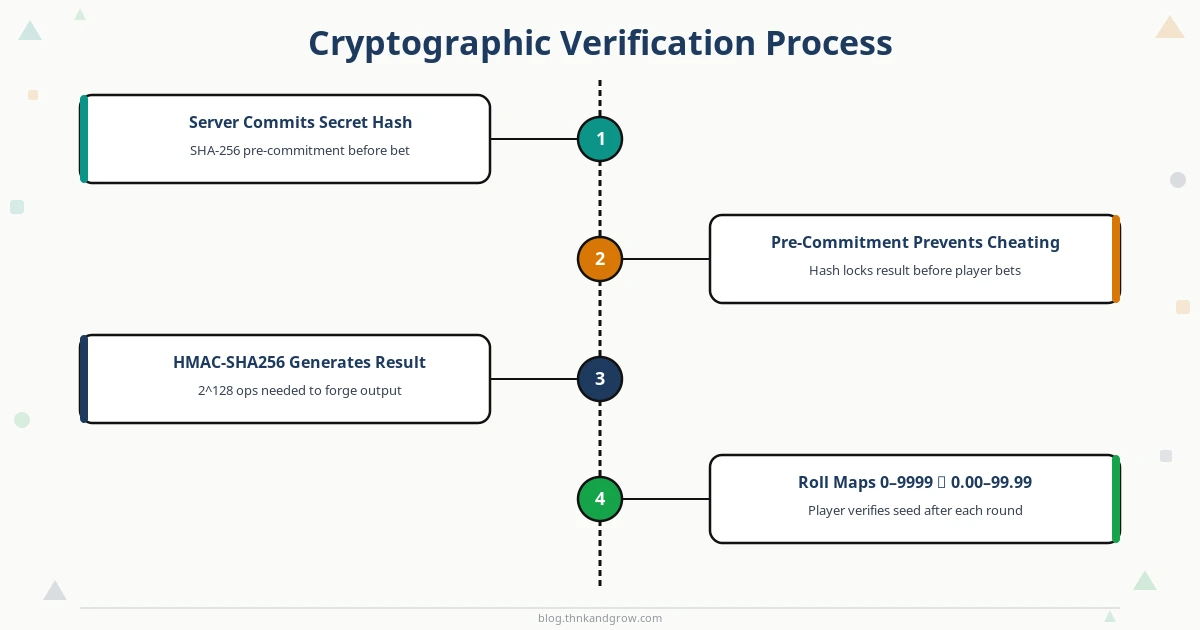
The sequence matters. Before a game round begins, the server generates a seed and computes its SHA-256 hash. That hash is published to the player. The seed itself is withheld. This is the commitment — the server has locked itself into a specific value without revealing it.
The game runs. The outcome is computed from the server seed, client seed, and current nonce. After the round, the server reveals the original seed. The player can now hash it themselves and confirm it matches what was published beforehand. If it matches, the commitment was genuine. If the outcome computed from those seeds and that nonce matches what was reported — the result was fair.
Why does pre-commitment with a hash prevent manipulation? Because SHA-256 is a one-way function. Finding a different input that produces the same hash — a collision — would require on the order of 2128 operations. No computing infrastructure that exists, or is plausibly near existence, can do that. The server cannot work backward from a desired game outcome to construct a seed that both matches the published hash and produces that outcome. It is computationally locked in.
A concrete example helps. Suppose you are playing a dice game where rolls from 0 to 9999 map to values between 0.00 and 99.99. The server publishes:
hashed_server_seed: 3f4e2a1b...
You set your client seed to myuniquekey and play round 1 (nonce = 1). After the round, the server reveals:
server_seed: a7c3f9e2b4d1...
You run: HMAC-SHA256(key: a7c3f9e2b4d1..., data: myuniquekey-1) in any standard crypto library. You get a hex string. Convert the first four hex characters to an integer, take modulo 10000, and you have your roll. If it matches what the game reported, the round was fair. This is not theoretical — any developer can replicate this in minutes, and several browser-based verification tools exist for players who do not write code.
The Evolution of Provably Fair: From Bitcoin Dice to ZK Proofs
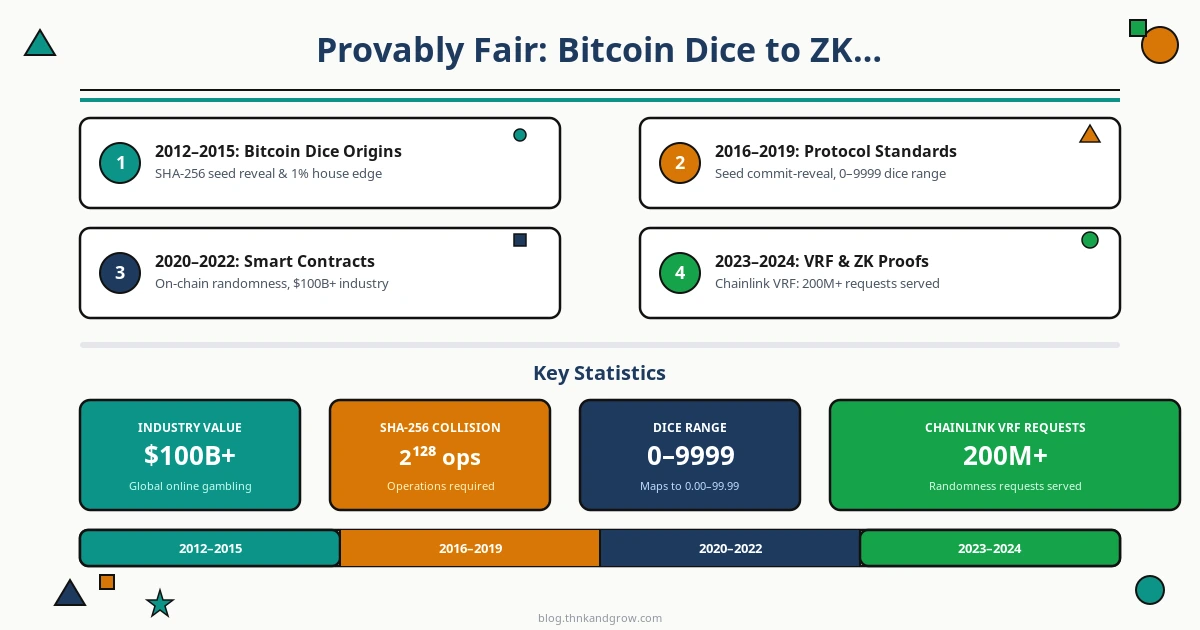
The origins were unglamorous. Satoshi Dice launched in 2012 as a Bitcoin betting site with a simple commitment scheme. Primedice followed with a cleaner implementation and more explicit documentation. These early systems were crude by current standards — minimal user tooling, limited transparency around seed generation — but they established the conceptual framework that everything since has built on.
Between 2016 and 2019, the industry converged on HMAC-SHA256 as the standard hashing scheme. Seeding mechanisms became more sophisticated. Platforms started offering seed rotation on demand, per-session seed histories, and public audit logs. The verification experience became something a non-developer could reasonably navigate.
The 2020 to 2022 period brought blockchain smart contracts into the picture. Rather than trusting a platform’s server to honestly reveal seeds after the fact, on-chain systems record commitments and outcomes in immutable transaction histories. An auditor — human or automated — can verify any historical round without needing the platform’s cooperation. The audit trail exists whether the operator wants it to or not.
Verifiable Random Functions arrived as a more rigorous formal primitive. A VRF produces a random output alongside a cryptographic proof that the output was computed correctly from a specific input, using a specific private key. Anyone with the corresponding public key can verify the proof without learning the private key. Chainlink VRF became the dominant implementation for smart contract applications, and by early 2026 has served over 200 million randomness requests across gaming and DeFi applications.
The current frontier is zero-knowledge proofs. ZKPs allow a prover to demonstrate that a computation was performed correctly without revealing the inputs. Applied to provably fair systems, this means a platform can prove an outcome was computed fairly without ever exposing the server seed — even after the fact. Privacy and auditability coexist. This has obvious appeal for platforms that currently treat revealed seeds as potential security liabilities, and for regulatory contexts where full seed disclosure creates compliance complexity.
Key Tools, Platforms, and Blockchain Solutions in 2026
Among gambling platforms, Stake.com maintains one of the more transparent implementations, with a comprehensive verification portal that lets users audit any historical round without external tools. BC.Game uses a hash-chain approach particularly suited to crash games, where the entire game history can be verified as a single linked structure. Primedice retains historical significance as an early adopter with open-source verification code. Rollbit offers a real-time fairness dashboard. Roobet emphasizes client seed customization with a relatively clean user interface for non-technical players.
For blockchain developers, Chainlink VRF v2.5 — released in 2025 — reduced on-chain gas costs substantially and introduced subscription-based funding, making it practical for high-frequency applications. API3 QRNG sources entropy from quantum hardware via oracle, adding a physical randomness layer to on-chain applications. Witnet provides decentralized oracle infrastructure with randomness primitives. Drand, maintained by Cloudflare and the League of Entropy, functions as a distributed randomness beacon used by Filecoin and other major protocols.
Layer 2 networks have changed the economics meaningfully. Arbitrum, Base, and Optimism now host provably fair games where on-chain verification costs a fraction of a cent per transaction. The barrier that made frequent on-chain auditing impractical on Ethereum mainnet largely disappears at L2.
At the infrastructure layer, some platforms are adding Hardware Security Modules to their seed generation pipeline. HSMs are tamper-resistant physical devices designed specifically for cryptographic operations. A server seed generated inside an HSM cannot be extracted or inspected even by the platform’s own staff — adding a physical security layer that complements the cryptographic guarantees.
Use Cases Beyond Gambling
NFT projects discovered provably fair mechanisms as a solution to trait assignment manipulation. When a collection mints, the randomness determining which traits a given token receives is a high-stakes operation — collectors pay premiums for rare traits, and any manipulation by the team is fraud. On-chain VRF implementations make the assignment process independently auditable by any token holder.
Blockchain governance has similar needs. PoolTogether, the no-loss lottery protocol, uses on-chain randomness to select prize winners. Ethereum’s proof-of-stake validator committee selection uses RANDAO, a commit-reveal scheme where randomness emerges from the XOR of validator contributions. Randomized governance is harder to capture than deterministic alternatives.
Esports and fantasy sports organizations have started using verifiable randomness for draft order determination and tournament bracket seeding. The practical value is straightforward: when significant money and competitive standing depend on a random draw, having a cryptographic proof of fairness reduces disputes and accusations of favoritism.
More surprisingly, randomized controlled trial design has begun incorporating cryptographic audit trails for participant selection. In contexts where research integrity is under scrutiny, a verifiable record that trial groups were assigned genuinely randomly — and that the randomization was committed to before enrollment — provides a form of pre-registration that is much harder to game than traditional documentation.
Best Practices for Operators and Users
For developers and operators building these systems, seed generation is the most critical point of failure. Server seeds must come from a cryptographically secure pseudorandom number generator. Using a timestamp, a block hash alone, or any predictable input undermines the entire scheme. Seed length should be at least 256 bits. Seeds should rotate per session, and ideally on user request mid-session. The verification algorithm itself should be open source — security through obscurity is not security.
Providing an accessible audit dashboard matters more than most operators seem to realize. A technically correct implementation that players cannot actually use is, practically speaking, not very different from no implementation. The friction of verification should be low enough that a motivated non-developer can check their results without hiring a cryptographer.
For users, the most important habit is changing the client seed before each session. A platform that knows your client seed in advance could theoretically pre-compute your outcomes — changing it removes that vector. Requesting periodic server seed rotations limits exposure if any seed is somehow compromised. And it is worth verifying a random sample of past rounds during normal play, not just rounds you suspect were unfair. Selective verification after a bad loss creates a biased sample and defeats much of the purpose.
The marketing distinction bears repeating for users evaluating platforms: a “provably fair” badge on a site tells you the outcome generation process was not manipulated. It says nothing about whether the game offers good value. A provably fair slot machine with a 15% house edge is still a bad bet. Read the return-to-player figures separately.
Regulatory Recognition and the Road Ahead
The Malta Gaming Authority has been the most proactive major regulator in formally incorporating provably fair systems into its compliance framework. Gibraltar and the Isle of Man have followed with similar recognition. This matters not because regulatory approval is necessary for a cryptographic guarantee to work — it is not — but because institutional acceptance accelerates adoption, creates audit standards, and gives legitimate operators a compliance pathway that didn’t previously exist.
Industry consortiums are pushing for unified cross-platform audit APIs, which would allow third-party verification tools to inspect outcomes across multiple platforms using a single interface. Standardization at this level would make the ecosystem significantly more auditable and reduce the per-platform implementation work that currently creates inconsistency.
Zero-knowledge proof integration is the most technically significant development on the near-term horizon. Current implementations require seed revelation, which creates an awkward window between commitment and disclosure. ZKP-based systems would allow continuous, private, independently verifiable fairness — a meaningful improvement that makes the technology more robust and more broadly applicable.
Conclusion
Provably fair algorithms represent a genuine paradigm shift in how trust operates in digital systems. The old model — institutional trust backed by audits, licensing, and reputation — is not worthless, but it is structurally dependent on intermediaries who may have interests in conflict with the participants they serve. The new model converts trust into a mathematical proof that anyone can verify, independently, without permission from the platform.
More than 85 percent of major crypto gambling platforms now implement some form of provably fair mechanism. Chainlink VRF has crossed 200 million randomness requests. The applications have expanded from Bitcoin dice games to NFT mints, validator selection, no-loss lotteries, and clinical trial design. Regulators who spent years ignoring these systems are now writing them into compliance standards.
The next several years will bring ZKP integration into mainstream implementations, cross-platform audit standardization, and continued expansion into any domain that requires verifiable randomness and cannot afford to ask participants to simply take their word for it. The trajectory is toward a world where verifiable fairness is a baseline expectation rather than a differentiating feature — where the question is not whether a system is provably fair, but which implementation of provably fairness it uses.
If you are evaluating a platform, learn to use the verification tools it provides and actually check a few rounds. If you are building a system that depends on randomness, the infrastructure exists to make it independently auditable and it is no longer particularly difficult to implement. The cryptographic primitives are solid, the tooling is mature, and the argument for opacity in randomized systems grows weaker with every year.


