PostgreSQL-First: One Database to Rule Them All in 2026
It started with a side project. A few days of what people generously call “vibe coding” — moving fast, making decisions by feel, seeing how far you can get before the seams start showing. And somewhere in the middle of wiring up a feature that I assumed would need a separate search service, I stopped and read the PostgreSQL documentation for the fifth time that week with fresh eyes.
The realization hit with the kind of quiet force that makes you put down your coffee and stare at the ceiling for a minute. This database — this supposedly boring, enterprise-y, “just use Postgres” database — could handle the transactional workload, the full-text search, the event notifications, the vector similarity queries, and the semi-structured data storage. All of it. From one connection string. With SQL.
I had spent years treating PostgreSQL as the reliable foundation you put underneath everything else. The thing you eventually move data away from when the system “gets serious.” But that framing was wrong. PostgreSQL in 2026 is not a stepping stone. For a wide class of systems — probably wider than you think — it is the destination.
This is the case for going PostgreSQL-first.
What Is the PostgreSQL-First Philosophy?
The PostgreSQL-First approach is straightforward enough to fit in a single sentence: consolidate around Postgres until your workload genuinely and demonstrably demands otherwise. The operative words there are “genuinely” and “demonstrably.” Not “eventually might,” not “theoretically could,” not “our CTO saw a tweet about Kafka.”
The default reflex in modern backend engineering runs in the opposite direction. You start a project and immediately reach for the canonical microservices data stack: a relational database for application state, Elasticsearch for search, Kafka or RabbitMQ for messaging, Snowflake or BigQuery for analytics, and maybe an S3-based data lake for the stuff that doesn’t fit anywhere else. Five services on day one, before you have a single real user.
This is the YAGNI principle applied to data infrastructure, and it is violated constantly. “You Ain’t Gonna Need It” is easy to understand in the context of application code — don’t build the abstraction until you need it. But engineers who would never pre-optimize a function will happily stand up a multi-service data platform for a system handling a few hundred requests per day.
The “boring technology” movement has been gaining real traction through 2025 and into 2026, partly as a correction to a decade of complexity inflation. The argument is not that Kafka and Snowflake are bad — it’s that they impose serious operational overhead, require specialized expertise to run well, and cost real money. If your workload doesn’t justify those costs, you’re paying a tax on complexity you chose unnecessarily.
PostgreSQL as Your Application Database (OLTP)
The foundational case doesn’t need much selling at this point. PostgreSQL’s ACID compliance is battle-tested across decades and billions of production transactions. Full CRUD support, mature transaction isolation levels, and a SQL dialect that remains one of the richest in the relational world.
What’s worth emphasizing is how much native capability exists before you touch a single extension. Role-based access control is built in — GRANT, Row-Level Security, pg_roles — which means you can implement multi-tenant isolation directly at the database layer without bolting on an external auth system. For teams building SaaS products, enabling RLS on your tables and writing policies that scope queries to the authenticated user’s organization is a serious security feature, not a workaround.
PostgreSQL 17, released in October 2024, brought meaningful improvements to vacuum performance (which matters enormously in high-write workloads), JSON_TABLE support conforming to the SQL/JSON standard, and incremental backup support that finally makes point-in-time recovery operationally manageable without third-party tooling. Logical replication from standbys, introduced in PostgreSQL 16, changes the operational picture for read scaling considerably.
Partitioning — Range, List, and Hash — has been production-ready since PostgreSQL 10 and has matured substantially. Combined with logical replication, you have the tools for horizontal scale patterns that can carry most applications well past the point where you’d expect to need a different system.
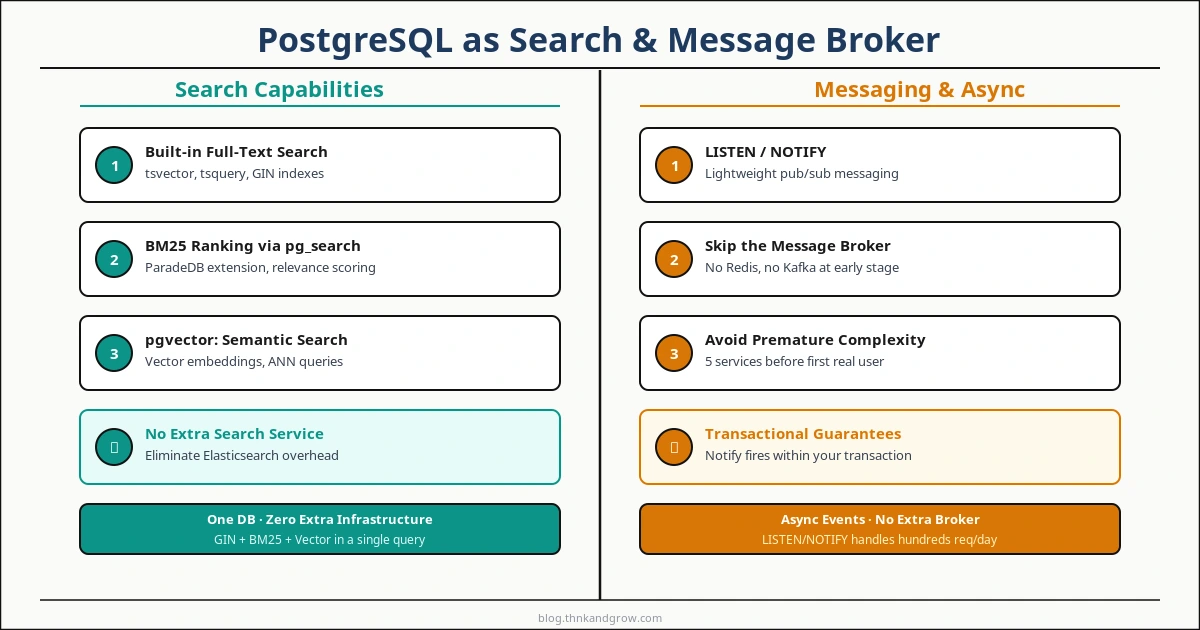
PostgreSQL as Search Engine and Message Broker
This is where engineers most frequently assume they need to graduate to specialized tools. And it’s where the PostgreSQL extension ecosystem has made the most dramatic progress.
Built-in full-text search using tsvector and tsquery handles more use cases than most teams realize. GIN indexes on tsvector columns give you ranked keyword search with language-aware stemming and stop words. For a product search, a documentation search, or an internal admin interface, this is often completely sufficient — and it eliminates an entire service from your stack.
When you need BM25 ranking, relevance tuning, and an Elasticsearch-grade search experience, pg_search from ParadeDB delivers it as a Postgres extension. The query interface is SQL. The index lives in your database. You don’t maintain a separate cluster, a separate sync pipeline, or a separate schema definition.

pgvector has become ubiquitous in the AI application stack. With HNSW and IVFFlat indexing now both production-stable, semantic search over embeddings is fully viable inside PostgreSQL. Vector databases like Pinecone and Weaviate are facing genuine competition from teams who correctly observe that storing embeddings next to the source data — in the same database, queryable with the same SQL — eliminates an entire category of consistency problems.
For messaging, PostgreSQL’s native LISTEN/NOTIFY mechanism is a legitimate lightweight pub/sub system. Clients subscribe to named channels; the database broadcasts notifications. For internal application events, cache invalidation, and real-time UI updates at moderate scale, this is zero-dependency messaging that requires nothing beyond your existing database connection.
For durable queues with at-least-once delivery guarantees, pgmq from Tembo and the SKIP LOCKED pattern together give you reliable job queue semantics. SKIP LOCKED in particular is an underappreciated feature — it lets multiple consumers pull from a queue table without row-level contention, which is exactly the behavior you need for parallel job processing.
PostgreSQL as API Layer and Integration Hub
One of the more surprising capabilities in the PostgreSQL ecosystem is how far you can get without writing application server code at all.
PostgREST introspects your PostgreSQL schema and auto-generates a fully functional REST API. Table permissions, Row-Level Security policies, and stored functions all translate directly into API behavior. You define your data model and your access rules in the database; PostgREST exposes them over HTTP. For internal tools and data APIs, this eliminates an entire application layer.
Hasura takes the same idea to GraphQL, generating a real-time GraphQL API from your Postgres schema with subscriptions backed by Postgres logical replication. Supabase wraps PostgREST, Postgres Auth, Storage backed by S3 with metadata in Postgres, a Realtime server built on Listen/Notify, and Edge Functions into a coherent Backend-as-a-Service that runs on PostgreSQL all the way down.
Foreign Data Wrappers deserve special mention as an integration mechanism. postgres_fdw lets you federate queries across multiple PostgreSQL instances transparently. mysql_fdw brings MySQL tables into your query planner. parquet_s3_fdw and duckdb_fdw let you query data lake files from within SQL. From the application’s perspective, these are just tables. The database handles the federation.
PostgreSQL as Data Lake and Lakehouse
JSONB has been a first-class citizen in PostgreSQL for long enough that this point is easy to understate. You can store semi-structured documents with full schema flexibility, index specific keys with GIN indexes, and query nested structures with standard SQL path expressions. This is a document database capability inside your relational database, without the consistency trade-offs of running a separate document store.
The lakehouse story got substantially more interesting with pg_lakehouse from ParadeDB, which lets you query S3 buckets, Parquet files, and Apache Iceberg tables directly from PostgreSQL using SQL. Combined with duckdb_fdw, which embeds DuckDB’s analytical engine as a Postgres extension, you can run high-performance analytical queries over data lake files from the same database your application already uses for transactional workloads.
For time-travel and historical data patterns, the temporal_tables extension or custom audit triggers with JSONB snapshots give you point-in-time query capability without a separate archival system.
PostgreSQL as Data Warehouse and BI Backend
The weakest part of the PostgreSQL-for-everything case has traditionally been analytical query performance. Columnar storage engines optimize for the access patterns that BI workloads demand — scanning large ranges of specific columns — while row-oriented storage like standard Postgres heap is optimized for transactional access patterns.
The extension ecosystem has moved aggressively to close this gap. pg_mooncake, released in 2024, brings columnar table storage to PostgreSQL with native Parquet and Apache Iceberg support. Hydra provides columnar heap storage as an extension. pg_analytics from ParadeDB uses Apache DataFusion as a vectorized query engine inside Postgres, delivering analytical query performance that is genuinely competitive for small-to-medium data volumes.
Google AlloyDB, a PostgreSQL-compatible managed database, takes this further with a built-in columnar engine that works across both OLTP and OLAP queries on the same data — no ETL, no sync pipeline, no separate warehouse. The same row that your application just wrote is immediately queryable via the columnar engine for analytical purposes.
Connecting Metabase, Grafana, or Apache Superset to PostgreSQL is trivial. They all speak standard SQL over a Postgres wire protocol connection. If your data is already in Postgres, your BI layer is one connection string away.
When PostgreSQL-First Makes Sense — and When It Doesn’t
The honest version of this argument requires acknowledging the limits.
PostgreSQL-First is the right default for startups, MVPs, small-to-medium production systems, and any team that doesn’t have dedicated infrastructure engineers who enjoy managing distributed systems. If you’re running Kafka with three brokers, a ZooKeeper ensemble, schema registry, and a team of one to maintain it because you have a message volume that would be perfectly fine with pgmq and a few queue consumers, you have made a costly mistake.
The managed Postgres cost comparison is stark. A production-grade setup on Supabase, Neon, or RDS costs a fraction of running Kafka plus Elasticsearch plus Snowflake — in both infrastructure spend and engineering time. For teams where DevOps bandwidth is constrained, that gap is the difference between shipping and maintaining.
But PostgreSQL will not replace Kafka at serious event streaming scale. When you’re talking about millions of events per second with multi-day retention, consumer group semantics, and stream processing pipelines, Kafka earns its operational overhead. PostgreSQL will not replace Snowflake for petabyte-scale warehousing with complex cross-table analytical queries over years of historical data. At that scale, the specialized tools exist for good reasons.
The right mental model is the graduation path: start with PostgreSQL handling as much as possible, measure actual bottlenecks, and extract individual services only when a specific, proven constraint forces the separation. Not when you anticipate future scale, not when a technology is fashionable — when a real bottleneck is demonstrated. Extract Elasticsearch when your full-text search is actually slow under real load, not before. Extract Kafka when your message volume actually saturates your queue, not in advance.
The Ecosystem in 2026: Platforms Making This Real
The PostgreSQL-First philosophy would remain largely theoretical without platforms that make it operationally viable. The ecosystem in 2026 is genuinely strong.
Supabase has matured into a production-grade BaaS that serious engineering teams use for real products, not just prototypes. Neon’s serverless PostgreSQL with Git-like database branching changes the development workflow in ways that make database schema iteration feel closer to application code — branch off a production database snapshot, test your migration, merge if it works. Tembo has built a curated stack marketplace that lets you spin up Postgres configured for specific workloads — OLAP, ML, messaging — without manually assembling the extension configuration yourself. ParadeDB has packaged search and analytics extensions into something coherent and production-deployable.
The unifying thread across all of these platforms is SQL. Every capability — transactional writes, full-text search, vector similarity, message queuing, lake queries, analytical aggregations — is accessible through standard SQL over the Postgres wire protocol. Your application engineers, your data engineers, your analytics engineers, and your BI developers all use the same interface. That is not a small thing. The cognitive overhead of maintaining expertise across five different query languages and five different consistency models is real, and it compounds as teams grow.
The Core Insight
PostgreSQL is not just a database. It is a data platform — one that in 2026 can credibly cover application storage, search, vector retrieval, pub/sub messaging, REST and GraphQL API generation, data lake queries, and columnar analytics through its extension ecosystem and surrounding tooling.
The smartest engineering decision is often not which specialized tool to adopt next, but whether you actually need it yet. The complexity that feels like sophistication on day one becomes operational debt by month six. Every service you add to your stack is a monitoring target, a failure domain, a schema synchronization problem, an expertise requirement, and a line item on your infrastructure bill.
For backend engineers, data engineers, analytics engineers, and BI developers building or scaling systems today, the investment with the highest return is a deep, thorough understanding of PostgreSQL and SQL. Not as a beginner-level skill to eventually graduate from, but as a primary competency. The engineers who know what PostgreSQL can actually do — not just the obvious CRUD operations but the full surface area of extensions, query planner internals, indexing strategies, and architectural patterns — will consistently outbuild and outship teams that reached for microservices complexity before they needed it.
Start PostgreSQL-first. Use one system, one query language, one operational surface. Measure your actual constraints. Extract complexity only when reality demands it — and when it does, extract it with confidence, because you’ll know exactly what you’re replacing and why.
The burden of proof should always be on adding another service, not on keeping things simple.


