Microsoft BitNet: The Future of 1-Bit AI Models
The artificial intelligence industry is facing a reckoning. Training and running large language models has become one of the most energy-intensive activities in modern computing. A single large-scale LLM inference cluster can consume as much electricity as tens of thousands of homes, and as demand for AI capabilities accelerates, so does the environmental and financial cost. For enterprises, researchers, and developers, this creates a painful paradox: the most capable AI models are often too expensive or resource-intensive to deploy at scale.
Microsoft Research may have found a way out of that paradox. BitNet — a groundbreaking research initiative focused on 1-bit large language models — challenges one of the most deeply held assumptions in AI: that powerful models must be expensive, energy-hungry, and GPU-dependent. By constraining model weights to the simplest possible values, BitNet delivers near full-precision performance at a fraction of the compute cost. The implications reach from hyperscale data centers all the way down to smartphones and embedded devices.
This post unpacks what BitNet is, how it has evolved, why it matters for the AI industry, and how engineers, enterprise decision-makers, and researchers can start working with it today.
What Is Microsoft BitNet?
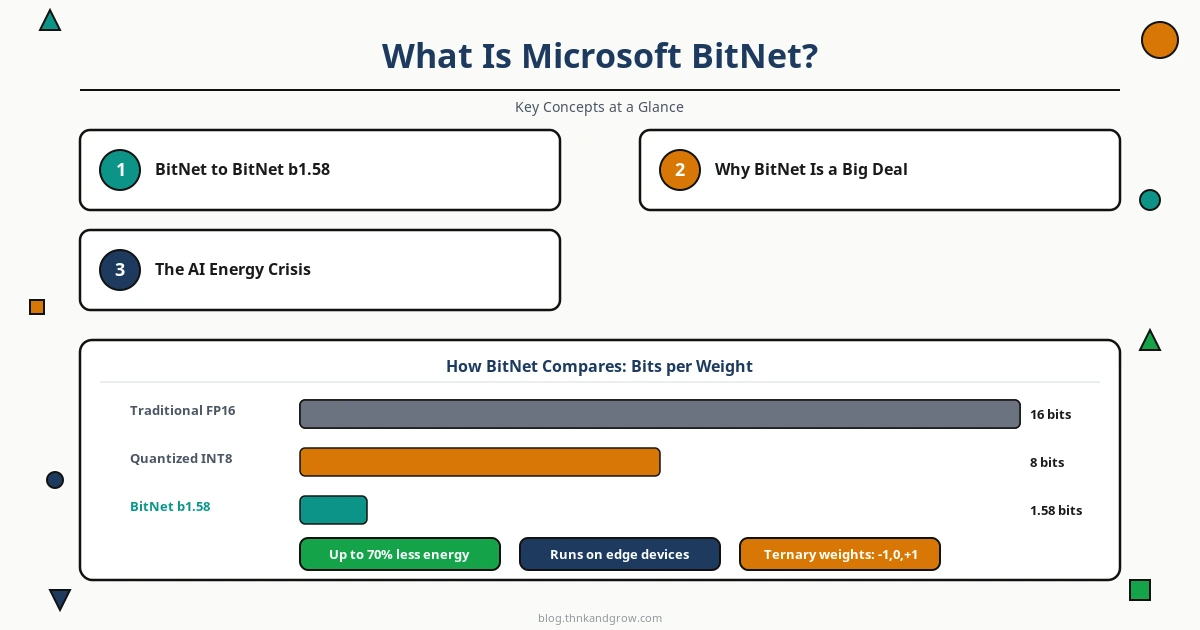
BitNet is a Microsoft Research project that rethinks the foundational architecture of large language models at the most fundamental level: the weight. In traditional neural networks, model weights are stored as 16-bit or 32-bit floating-point numbers — a format that enables high numerical precision but demands enormous memory bandwidth and computational resources during inference.
BitNet takes a radically different approach. Instead of floating-point weights, BitNet constrains every weight in the model to one of just three possible values: -1, 0, or +1. This is the essence of a 1-bit or ternary model. The mathematical operations that dominate transformer inference — primarily matrix multiplications — can be replaced with far simpler addition and subtraction operations, eliminating the need for expensive floating-point arithmetic.
The project traces its origins to a landmark paper published in October 2023: “BitNet: Scaling 1-bit Transformers for Large Language Models.” The research was led by a team at Microsoft Research including Furu Wei (Principal Researcher), Shuming Ma, and Li Dong, among other contributors. Their central claim was bold: that 1-bit models, when trained at sufficient scale, can match the performance of full-precision counterparts — not as a rough approximation, but as genuine competitive alternatives.
From BitNet to BitNet b1.58: The Evolution
The original 2023 BitNet paper established the proof of concept. By replacing standard Linear layers with BitLinear layers — which quantize weights to binary values during the forward pass while maintaining a higher-precision latent representation during training — the team demonstrated that 1-bit transformers could scale effectively. The key insight was that performance parity with full-precision models emerged as model size increased, suggesting that scale and efficiency were not fundamentally at odds.
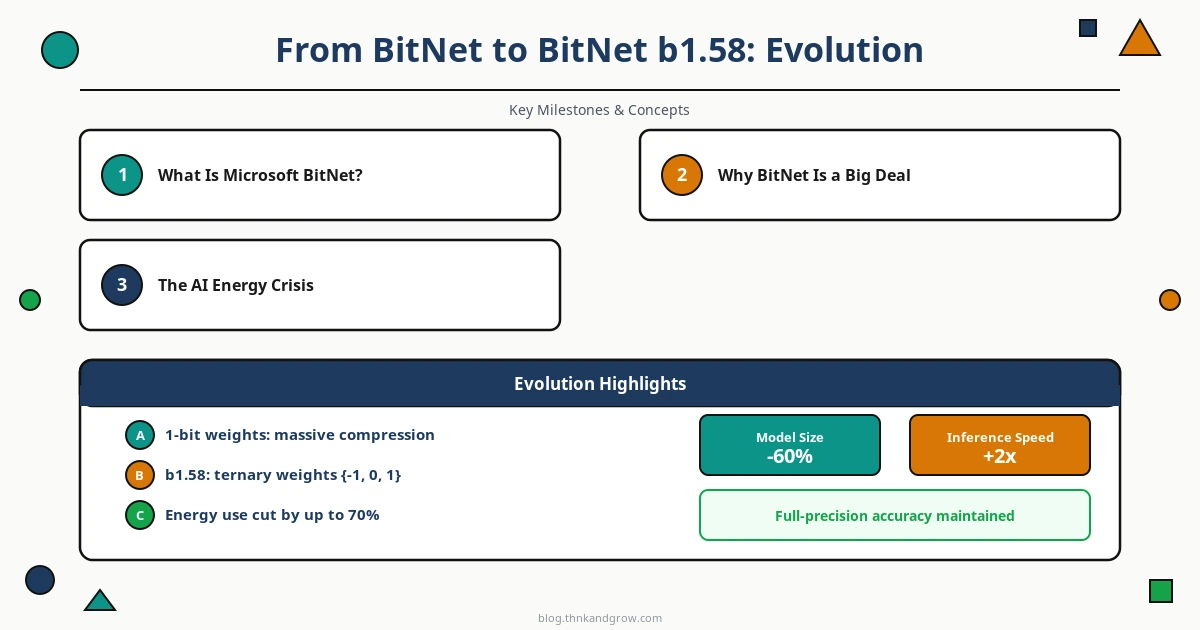
The follow-up paper, published in February 2024 and titled “The Era of 1-bit LLMs: All Large Language Models are in 1.58 Bits,” introduced BitNet b1.58 — the version that truly captured the AI community’s attention. The “1.58” in the name is mathematically precise: ternary weights (-1, 0, +1) require log₂(3) ≈ 1.58 bits to represent, making the name both accurate and descriptive.
The benchmark results from BitNet b1.58 were striking:
- 2.71x faster inference compared to equivalent full-precision LLaMA models
- 3.55x less memory usage at equivalent parameter scale
- Matching perplexity and downstream task performance at 3 billion parameters and above
- Significant energy reduction per inference token, directly addressing the AI power consumption problem
The introduction of the zero value in ternary weights was more than a minor tweak. It allowed the model to effectively “turn off” certain connections, introducing a form of learned sparsity that improved both representational capacity and computational efficiency simultaneously.
Research continued into late 2024 with BitNet a4.8, which introduced 4-bit activations alongside 1-bit weights. While previous versions focused on compressing weights, activations had remained at higher precision. BitNet a4.8 pushed the efficiency frontier further, opening the door to even more aggressive on-device deployment scenarios where every bit of memory and every watt of power matters.
Why BitNet Is a Big Deal for the AI Industry
The significance of BitNet extends well beyond academic benchmarks. It addresses several of the most pressing structural problems facing the AI industry today.
The AI Energy Crisis
Data centers running large language models are consuming electricity at rates that are straining power grids and raising serious sustainability concerns. BitNet directly reduces the energy footprint of inference by replacing floating-point multiply-accumulate operations with integer additions — operations that consume dramatically less power at the hardware level. For organizations running millions of inference requests per day, this translates into measurable reductions in both carbon emissions and electricity bills.
Democratization of AI
Perhaps the most transformative implication of BitNet is what it means for access. Today, running a capable LLM at scale requires dedicated GPU infrastructure — hardware that is expensive to purchase, operate, and maintain. BitNet’s CPU-only inference capability changes that equation entirely. A powerful language model could run on a standard laptop, a smartphone, or an embedded device without any specialized hardware. This opens the door to AI applications in regions, industries, and organizations that have been effectively locked out by infrastructure costs.
Enterprise Cost Reduction
For enterprise AI deployments on Azure or on-premises infrastructure, the cost implications of 2.71x faster inference and 3.55x lower memory usage are significant. Organizations can serve more requests per compute unit, reduce the number of inference servers required, and lower their total cost of ownership for AI-powered applications — all without sacrificing model quality.
Strategic Alignment with Microsoft’s AI Vision
BitNet fits naturally within Microsoft’s broader AI strategy. As the company deepens its integration of AI across Azure, Microsoft 365, Windows, and its partnership with OpenAI, having a research foundation in efficient model architectures positions Microsoft to offer AI capabilities that are both powerful and economically sustainable at enterprise scale.
Key Tools and Frameworks in the BitNet Ecosystem
BitNet has moved well beyond pure research into a growing practical ecosystem.
bitnet.cpp
Microsoft’s official inference framework, available at github.com/microsoft/BitNet, is a C++ library designed for CPU-only deployment of BitNet models. It includes optimized kernels for both x86 (AVX2) and ARM (NEON) architectures, achieving speedups ranging from 1.37x to over 5x depending on the hardware. This is the recommended starting point for anyone looking to deploy BitNet models in production or experiment with the technology locally.
Microsoft’s Broader Toolchain
- ONNX Runtime — Microsoft’s cross-platform inference engine, compatible with BitNet model exports
- DeepSpeed — Microsoft’s distributed training library, relevant for training large BitNet models efficiently
- Olive — Microsoft’s model optimization toolkit for preparing models for efficient deployment
- Azure Machine Learning — The cloud platform for training and serving BitNet-based models at scale
Community Ecosystem
Adoption beyond Microsoft has been rapid. The popular open-source inference engine llama.cpp added BitNet support, bringing 1-bit model inference to a massive existing user base. BitNet model variants are hosted on Hugging Face, making them accessible through the standard Transformers API. Training is compatible with PyTorch, the dominant framework in AI research.
It is worth noting a critical distinction between BitNet and competing quantization approaches like GPTQ or AWQ. Those methods apply quantization to already-trained full-precision models — a process called post-training quantization. BitNet models are trained from scratch with quantization built into the training process from the start. This architectural distinction is why BitNet achieves superior efficiency: the model learns to represent knowledge within the constraints of ternary weights rather than having those constraints imposed after the fact.
Real-World Use Cases for BitNet
The practical applications of BitNet span a wide range of deployment contexts.
Edge AI and On-Device Intelligence
Running LLMs on smartphones, IoT devices, embedded automotive systems, and offline laptops becomes genuinely feasible with BitNet. A medical device that needs natural language understanding without cloud connectivity, an automotive assistant that works without network access, or a field tool for industrial workers in remote locations — all of these scenarios benefit directly from models that run on standard CPUs with minimal power draw.
Cost-Efficient Cloud Inference
For cloud-native applications, BitNet’s efficiency gains translate directly into lower Azure compute bills. Organizations can serve more users per inference node, handle traffic spikes more gracefully, and reduce the GPU dependency that currently makes AI infrastructure so capital-intensive.
Enterprise On-Premises Deployment
Industries with strict data sovereignty requirements — healthcare, finance, legal, government — often cannot send sensitive data to external cloud APIs. BitNet makes it practical to run capable language models entirely on-premises, on standard server hardware, without the cost and complexity of maintaining a GPU cluster.
Research and Education
Smaller academic institutions and independent researchers who lack access to expensive GPU infrastructure can now experiment with LLMs at meaningful scale. This has the potential to significantly broaden participation in AI research and accelerate innovation from outside the well-funded labs that currently dominate the field.
Specialized Domain Models
Training domain-specific BitNet models for medical documentation, legal analysis, financial reporting, or multilingual applications becomes economically viable for organizations that previously could not afford the compute required to train or serve custom LLMs.
Best Practices for Working with BitNet
For teams ready to move from curiosity to implementation, here are the key practices that make the difference between a successful BitNet deployment and a frustrating one.
Training
- Use
BitLinearlayers as drop-in replacements for standardLinearlayers in your transformer architecture - Train from scratch — do not attempt to quantize an existing full-precision model, as this will not produce the efficiency gains BitNet is designed to deliver
- Apply absmax quantization for activations to maintain numerical stability during training
- Use slightly higher learning rates than standard transformer training and tune weight decay carefully, as binary weight regularization behaves differently from floating-point regularization
Inference
- Deploy with bitnet.cpp for CPU inference rather than relying on generic frameworks that are not optimized for ternary weight operations
- Leverage ARM NEON on mobile and embedded platforms or AVX2 on x86 servers for maximum throughput
- Batch requests where possible — BitNet benefits from larger batch sizes that amortize the overhead of the inference pipeline
Deployment
- Start with models at 3 billion parameters or larger, where BitNet b1.58 demonstrates the strongest performance parity with FP16 models
- Always benchmark on your specific target hardware — speedup ratios vary significantly between ARM and x86 architectures
- Consider hybrid approaches where BitNet weights are combined with higher-precision embeddings for applications requiring fine-grained token representation
What’s Next for Microsoft BitNet?
The trajectory of BitNet research and adoption points toward several significant developments on the horizon.
Integration with Azure AI and the Windows AI platform seems like a natural next step, potentially enabling BitNet-powered models to run natively on Windows devices as part of Microsoft’s on-device AI strategy. The efficiency profile of BitNet aligns perfectly with the constraints of consumer hardware.
Microsoft’s Phi series of small language models — already notable for punching above their weight class in capability — shows clear influence from the efficiency research that BitNet represents. Future Phi models may incorporate BitNet-style training approaches to push the capability-per-watt ratio even further.
Perhaps most significantly, semiconductor companies are beginning to take notice. Hardware designed specifically for ternary weight operations — where the dominant compute primitive is addition rather than floating-point multiplication — could deliver order-of-magnitude improvements over general-purpose silicon. If BitNet becomes a standard training paradigm, it could reshape the AI chip market over the next several years.
The broader industry trend toward efficient AI is accelerating. As regulatory pressure around AI energy consumption grows and the economics of GPU infrastructure remain challenging, the value proposition of approaches like BitNet becomes increasingly compelling for enterprises and developers alike.
Conclusion
Microsoft BitNet is not a research curiosity or an academic footnote. It represents a fundamental rethinking of how large language models are built, trained, and deployed — one that has the potential to reshape the economics and accessibility of AI across every industry and use case.
The combination of near-parity performance with full-precision models, dramatic efficiency gains in memory and inference speed, CPU-only deployment capability, and a growing open-source ecosystem makes BitNet one of the most important AI efficiency breakthroughs of the current era. It directly addresses the energy crisis in AI infrastructure, democratizes access to powerful language models for organizations without GPU budgets, and opens entirely new deployment contexts that were previously impractical.
Whether you are an ML engineer optimizing inference costs, an enterprise architect evaluating on-premises AI, a researcher working with limited compute, or a startup founder trying to build AI products without burning through infrastructure budgets, BitNet deserves your serious attention right now.
The best place to start is the official bitnet.cpp repository on GitHub (github.com/microsoft/BitNet), where you can run 1-bit models on your own hardware today. Pair that with the original BitNet and BitNet b1.58 research papers from Microsoft Research, and you will have everything you need to understand and experiment with what may well be the architecture that defines the next chapter of efficient AI deployment.
The era of expensive, resource-hungry AI as the only option is ending. BitNet is one of the clearest signals of what comes next.


