Microsoft BitNet Explained: 1-Bit AI That Changes Everything
The AI industry has a dirty secret: the most powerful language models in the world are extraordinarily expensive to run. Training a frontier LLM can cost tens of millions of dollars, but the real financial and environmental pain comes from inference — serving billions of requests every day across GPU clusters that consume as much electricity as small cities. For most organizations, this creates an uncomfortable tradeoff: either pay the premium for capable AI, or settle for smaller, less capable models that fit within a realistic budget.
Microsoft Research’s BitNet challenges that tradeoff at its foundation. Rather than accepting that large language models must be expensive and energy-hungry, a team of researchers asked a radical question: what if model weights didn’t need 16 or 32 bits of floating-point precision at all? What if a single bit — just +1 or -1 — was enough? The answer, it turns out, is that it very nearly is. And that insight is quietly reshaping how the AI industry thinks about model efficiency, edge deployment, and sustainable computing.
This post breaks down everything you need to know about BitNet: what it is, how it works, how it compares to other quantization approaches, and how you can start using it today — on your laptop, without a GPU.
What Is BitNet? The Core Idea Behind 1-Bit LLMs
To understand BitNet, you first need to understand what “precision” means in the context of neural network weights. In a standard Transformer-based LLM, each weight parameter is stored as a 16-bit floating-point number (FP16) or a 32-bit float (FP32). These high-precision formats allow the model to represent a vast range of values with fine granularity, which is important during training when gradients need to be tracked accurately.
The problem is that high precision is expensive. A 7-billion-parameter model stored in FP16 requires roughly 14 gigabytes of memory just to hold the weights — before you account for activations, the KV cache, or any batch processing overhead. Multiply that across thousands of inference requests per second, and you’re looking at serious hardware requirements.
BitNet, introduced in a 2023 paper titled “BitNet: Scaling 1-bit Transformers for Large Language Models” by Microsoft Research, takes a dramatically different approach. The key innovation is replacing the standard nn.Linear layers inside a Transformer architecture with custom BitLinear layers, where weights are binarized to either +1 or -1. That’s it — no floating-point representation, no 16-bit precision, just a single bit per weight.
The research team, led by Hongyu Wang and co-authored by Shuming Ma and senior researcher Furu Wei of Microsoft Research Asia, demonstrated that models trained with this architecture could scale effectively while maintaining competitive performance. Critically, BitNet isn’t applied as an afterthought — the quantization is baked into the training process from the start, which is what separates it fundamentally from conventional compression techniques.
BitNet b1.58: The Ternary Upgrade That Matched Full Precision
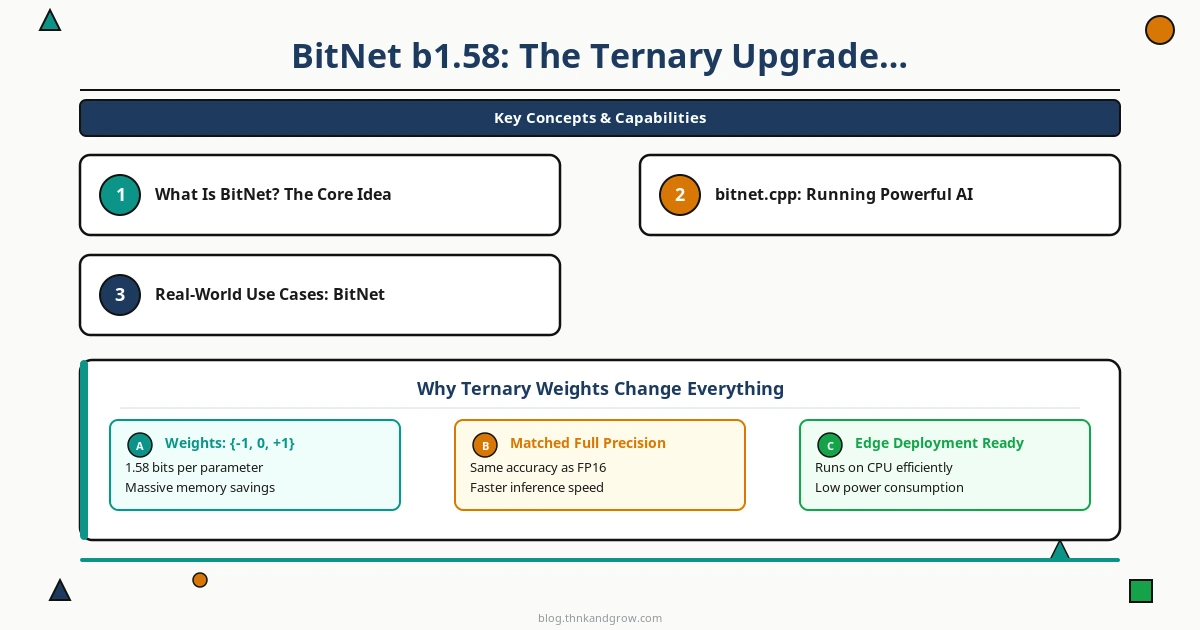
The original 1-bit BitNet was impressive, but the real breakthrough came in February 2024 with the release of BitNet b1.58. This updated architecture extends the weight representation from binary to ternary, allowing each weight to take one of three values: {-1, 0, +1}.
The name “b1.58” is a nod to information theory: log₂(3) ≈ 1.58, meaning each ternary weight carries approximately 1.58 bits of information. That’s still a fraction of the 16 bits used in standard models, but the addition of zero as a possible weight value turns out to be enormously significant for model expressiveness.
The landmark result from the b1.58 paper was striking: BitNet b1.58 achieved near-identical perplexity scores and downstream task performance compared to full-precision FP16 models of equivalent parameter counts. This wasn’t a marginal gap that practitioners might accept as a reasonable tradeoff — it was genuine parity across a range of benchmarks.
What makes this mathematically elegant is what ternary weights do to matrix multiplication. In a standard LLM, the most computationally expensive operation is the matrix multiply — multiplying large matrices of floating-point weights against floating-point activations. With ternary weights of {-1, 0, +1}, you no longer need floating-point multiplication at all. Multiplying by +1 is a no-op, multiplying by -1 is a negation, and multiplying by 0 zeroes out the result. The entire operation reduces to addition and subtraction — operations that are orders of magnitude cheaper in hardware than floating-point multiply-accumulate units.
This isn’t just a theoretical nicety. It means BitNet b1.58 can run efficiently on hardware that lacks dedicated floating-point units — which describes the vast majority of CPUs, microcontrollers, and edge devices in the world.
bitnet.cpp: Running Powerful AI on Your Laptop CPU
Understanding the theory is one thing. The practical question is: does it actually work in the real world, on real hardware? Microsoft answered this definitively with the release of bitnet.cpp, an official open-source inference framework hosted at microsoft/BitNet on GitHub.
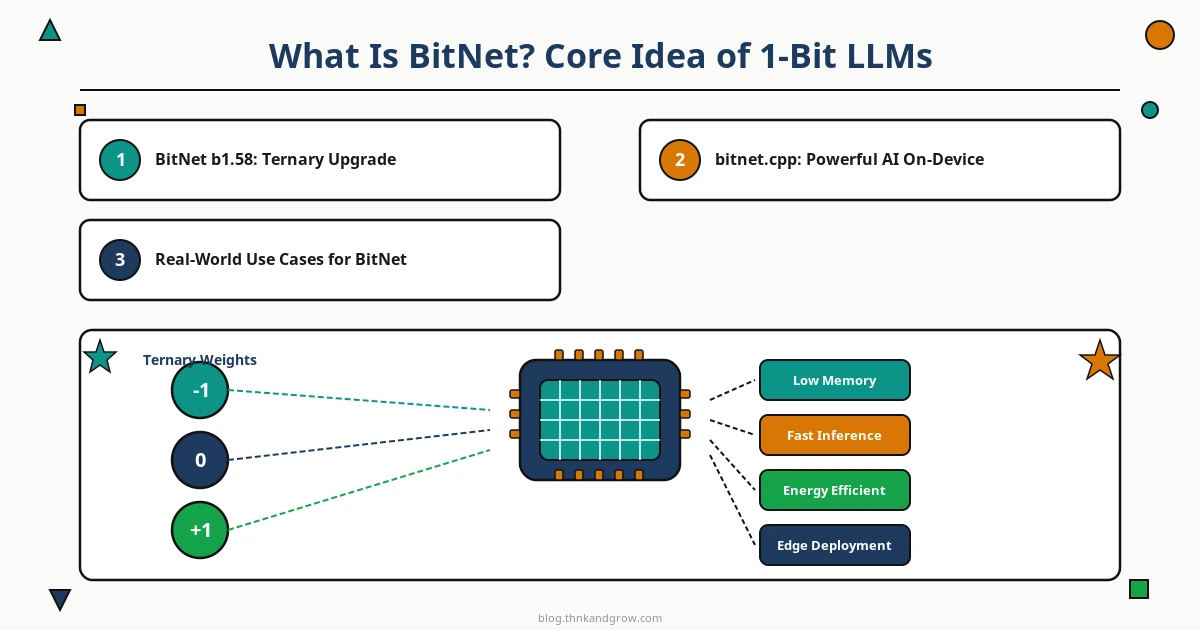
bitnet.cpp is purpose-built for CPU inference of BitNet b1.58 models. Unlike general-purpose inference frameworks that treat quantized models as a special case, bitnet.cpp is architected from the ground up to exploit the mathematical properties of ternary weights — specifically, the ability to replace floating-point matrix multiplications with efficient integer addition operations.
The benchmark results are hard to argue with:
- 1.37x to 5.07x speedup on ARM CPUs compared to llama.cpp running equivalent-sized models
- 55% to 70% energy savings on ARM hardware — a reduction that matters both for battery life on edge devices and electricity costs at scale
- Support for both ARM and x86 architectures, covering the vast majority of laptops, servers, and single-board computers
- Compatibility with Hugging Face model formats, making it easy to pull pre-trained BitNet models and run them immediately
To put this in concrete terms: a BitNet b1.58 model with 3 billion parameters can run inference on a standard laptop CPU — no GPU, no cloud, no expensive hardware — at speeds that are genuinely useful for interactive applications. That’s a capability that simply didn’t exist at this quality level before BitNet.
Getting started is straightforward for anyone already comfortable with command-line tools:
# Clone the official repository
git clone https://github.com/microsoft/BitNet.git
cd BitNet

# Install dependencies
pip install -r requirements.txt

# Run inference with a pre-trained model
python run_inference.py -m models/bitnet_b1_58-3B -p "Explain transformer attention in simple terms"
Real-World Use Cases: Where BitNet Makes the Biggest Impact
BitNet’s efficiency gains aren’t just impressive numbers in a research paper — they unlock genuinely new deployment scenarios that were previously impractical.
Edge AI Without a GPU
The most immediate application is running capable language models on devices that have never been able to host them: smartphones, Raspberry Pi boards, embedded industrial controllers, and offline kiosk systems. BitNet b1.58’s elimination of floating-point matrix multiplication means that even ARM Cortex-A processors — the kind found in mid-range Android phones — can run meaningful LLM inference. This opens the door to private, on-device AI assistants that never send data to the cloud.
Cloud Inference Cost Reduction
For organizations running high-volume inference workloads on Azure or other cloud providers, the economics of BitNet are compelling. Faster inference per CPU core means fewer compute resources needed to serve the same request volume. The 55–70% energy reduction translates directly to lower electricity costs. For enterprises processing millions of tokens per day through AI pipelines, these savings can be substantial — and they compound as usage scales.
Green AI and ESG Alignment
Microsoft has publicly committed to becoming carbon-negative by 2030. Running AI workloads that consume 70% less energy is a concrete step toward that goal. For enterprise technology leaders with Environmental, Social, and Governance reporting requirements, BitNet offers a way to expand AI capabilities without proportionally expanding the organization’s carbon footprint — a genuinely rare combination.
Democratizing AI Development
Not every developer works at a company with a six-figure GPU budget. In regions where GPU cloud instances are expensive, unreliable, or simply unavailable, BitNet changes the calculus for what’s possible. A developer with a modern laptop and a Hugging Face account can now experiment with, fine-tune, and deploy capable language models without ever touching a GPU — lowering the barrier to AI development in a meaningful way.
BitNet vs. Other Quantization Approaches
BitNet exists in a landscape that already includes several well-established quantization techniques. Understanding where it differs is important for making informed architectural decisions.
GPTQ and AWQ are the most widely used post-training quantization methods today. They take a fully trained FP16 model and compress it after the fact — reducing weights to 4-bit or 8-bit integers with various calibration techniques to minimize accuracy loss. These approaches work well and have broad toolchain support, but they have a fundamental limitation: you’re compressing a model that was never designed to be compressed. The quantization is applied after training, which means the model’s internal representations were optimized for full-precision arithmetic. Some accuracy loss is essentially unavoidable.
BitNet is architecturally different. Quantization is part of training from the very beginning. The model learns to represent information using ternary weights, which means its internal representations are optimized for that constraint rather than fighting against it. This is why BitNet b1.58 achieves genuine parity with full-precision models rather than the slight-but-measurable degradation typical of post-training quantization.
Apple MLX and Google’s Gemma quantization efforts are focused on efficient inference on specific hardware — Apple Silicon and Google TPUs, respectively. These are excellent solutions within their ecosystems, but they’re hardware-specific optimizations rather than architectural innovations. BitNet’s approach is hardware-agnostic: because ternary arithmetic maps to simple integer operations, it benefits any processor that handles integer math efficiently — which is essentially all of them.
The key philosophical distinction: GPTQ and AWQ compress existing models. BitNet redesigns the architecture. That’s a fundamentally different bet, and the results suggest it’s the right one.
How to Get Started with BitNet Today
The good news for practitioners is that BitNet is not locked behind a research preview or enterprise agreement. Everything you need is publicly available right now.
- GitHub Repository:
microsoft/BitNet— contains bitnet.cpp, documentation, and setup scripts - Pre-trained Models: Available on Hugging Face Hub under Microsoft’s organization — search for
microsoft/bitnet-b1.58variants - Recommended Starting Point: Use bitnet.cpp for CPU inference rather than attempting to train from scratch. Pre-trained models are available and ready to run
- Training Environment: For advanced users who want to train custom BitNet models, the implementation is built on PyTorch, and Azure Machine Learning provides a managed environment with the compute and experiment tracking needed for serious training runs
- llama.cpp Integration: If you’re already in the llama.cpp ecosystem, community-maintained forks support BitNet model formats, allowing you to use familiar tooling with BitNet weights
For most engineers evaluating BitNet for the first time, the recommended path is: clone the repo, download a pre-trained model from Hugging Face, and run bitnet.cpp on your local machine. The performance difference compared to running an equivalent quantized model through llama.cpp is immediately apparent.
What’s Next: The Road Ahead for BitNet
BitNet’s current focus is on language models, but the research directions being explored suggest a much broader ambition. Microsoft Research is actively investigating BitNet architectures for vision models and multimodal AI — applying the same 1-bit weight principles to image encoders and cross-modal attention mechanisms. If the language model results hold for vision, the implications for on-device computer vision are significant.
On the deployment side, ONNX Runtime integration is a natural next step. ONNX Runtime is Microsoft’s cross-platform inference engine, and bringing BitNet support into that ecosystem would dramatically expand the range of deployment targets — from Windows applications to WebAssembly to mobile frameworks.
At the hardware level, researchers are exploring ARM NPU and IoT chip optimizations specifically designed around ternary arithmetic. Today’s efficiency gains come from mapping ternary operations to existing integer units. Chips designed natively for ternary computation could deliver another order-of-magnitude improvement.
The broader question the community is beginning to ask is genuinely interesting: could 1-bit models eventually replace full-precision models as the default for production AI? The current evidence suggests that for inference — serving requests from a trained model — ternary weights are already competitive. The remaining challenge is training, which still requires higher-precision arithmetic for gradient computation. Research into fully 1-bit training pipelines is ongoing, and if that problem is solved, the case for full-precision production models becomes much harder to make.
Conclusion: A Paradigm Shift Worth Taking Seriously
BitNet is not a research curiosity or a clever trick that works only in carefully controlled benchmark conditions. It is a fundamental rethinking of how large language models represent and compute information — one that has already demonstrated near-full-precision performance in real evaluations, backed by a credible research team at one of the world’s leading AI labs.
The combination of achievements here is rare: near-identical model quality, up to 5x faster CPU inference, 70% lower energy consumption, and a deployment story that works on hardware most people already own. Each of those improvements individually would be notable. Together, they represent one of the most practically significant AI efficiency breakthroughs in recent years.
For AI engineers evaluating inference cost reduction strategies, BitNet belongs on your shortlist — not as a future consideration, but as something to benchmark against your current stack today. For cloud architects designing scalable AI pipelines, the economics of ternary inference at scale are worth running through your cost models. For technology leaders with sustainability commitments, BitNet is one of the few efficiency techniques that delivers meaningful energy reduction without a meaningful quality tradeoff.
The tools are open-source, the models are on Hugging Face, and bitnet.cpp runs on the laptop you’re using right now. The future of efficient AI isn’t a roadmap item — it’s already available to try. Start with the microsoft/BitNet repository, pull a pre-trained model, and see for yourself what 1-bit inference actually feels like in practice. You might be surprised how little you miss those extra 15 bits.


