ByteOver: Understanding Byte Boundary Risks in Code
Some of the most catastrophic software failures in history share a surprisingly humble origin story. Heartbleed exposed the private keys of millions of HTTPS servers because of a missing bounds check on a single length field. EternalBlue — the exploit that powered WannaCry and NotPetya — leveraged a buffer overflow in Windows SMB to cause an estimated $10 billion in global damages. A smart contract integer overflow on the BEP-20 token standard once allowed an attacker to mint quadrillions of tokens from thin air. The common thread running through all of them? Bytes going where they shouldn’t.
This post introduces ByteOver as a unified lens for understanding an entire family of byte boundary violations — buffer overflows, integer overflows, byte overruns, and off-by-one errors. Rather than treating these as isolated bugs, thinking about them together as a class of conditions helps developers recognize patterns, apply the right defenses, and build more resilient systems from the ground up.
In 2024–2025, this topic is not just evergreen — it is increasingly urgent. Memory-unsafe code still dominates embedded systems, network stacks, and legacy infrastructure. Regulatory bodies are starting to mandate memory safety practices. And the tools available to both attackers and defenders have never been more sophisticated. Whether you’re writing firmware for a microcontroller, parsing network packets in a high-throughput service, or reviewing a pull request in a security-critical codebase, understanding ByteOver conditions is foundational knowledge you cannot afford to skip.
This post is part of a series exploring low-level security concepts. If you’ve landed here from a related article on memory safety or exploit development, you’re in the right place — the concepts build on each other intentionally.
What Does ‘ByteOver’ Actually Mean?
At its core, a ByteOver condition is any situation where data exceeds its allocated byte boundary. Think of it like filling a glass of water: the glass has a fixed capacity, and pouring beyond that capacity doesn’t make the water disappear — it spills onto the table, potentially damaging whatever is nearby. In computing, that “nearby” area is memory belonging to other variables, return addresses, or security-critical data structures.
ByteOver is an umbrella term covering four core variants:
- Buffer Overflow: Writing data beyond the end of a fixed-size memory buffer. The classic example is copying a 200-byte string into a 100-byte array — the excess 100 bytes overwrite adjacent memory.
- Integer Overflow: An arithmetic operation produces a result that exceeds the maximum value representable by the integer type. A
uint8_tholding the value 255 that gets incremented wraps around to 0, silently corrupting logic that depends on a monotonically increasing counter. - Byte Overrun: In serial and network communication, incoming data arrives faster than the receiver can process it, causing the receive buffer to overflow and data to be lost or corrupted.
- Off-by-One Error: A loop or pointer operation exceeds its intended boundary by exactly one unit. These are deceptively subtle — a loop that runs
i <= lengthinstead ofi < lengthwrites one byte past the end of an array, which is often enough to overwrite a critical value.
Why group these together? Because they share the same root cause — a failure to enforce byte boundaries — and they share the same remediation philosophy: validate inputs, check bounds, and prefer languages or tools that enforce these constraints automatically. Understanding them as a unified concept makes it easier to recognize the pattern in unfamiliar code and apply the right fix.
Why Byte Boundary Violations Are Still a Top Threat
You might assume that after decades of awareness, these vulnerabilities would be largely solved. They are not. According to MITRE's CWE Top 25 for 2023–2024, CWE-787 (Out-of-bounds Write) and CWE-125 (Out-of-bounds Read) remain firmly in the top five most dangerous software weaknesses. They have held those positions for years running.
The landmark exploits speak for themselves:
- Heartbleed (CVE-2014-0160): A missing bounds check in OpenSSL's heartbeat extension allowed attackers to read up to 64KB of server memory per request — silently, without leaving logs. Private keys, session tokens, and passwords were exposed at scale.
- EternalBlue (CVE-2017-0144): A buffer overflow in the Windows SMB protocol, allegedly developed by the NSA and later leaked by the Shadow Brokers, became the engine behind WannaCry and NotPetya. The estimated global economic damage exceeded $10 billion.
- Smart Contract Integer Overflows: Before Solidity 0.8.0 introduced automatic overflow checks in 2020, integer overflows in Ethereum smart contracts caused hundreds of millions of dollars in losses. The BEP-20 and ERC-20 ecosystems were riddled with contracts where unchecked arithmetic allowed attackers to wrap token balances to astronomically large values.
The financial and reputational damage from these vulnerabilities is staggering, yet byte boundary bugs persist. Why? Two primary reasons: the enormous volume of legacy C and C++ code that cannot be easily rewritten, and the reality that developer oversight — especially under time pressure — still produces these errors even in new codebases. The attack surface is not shrinking.
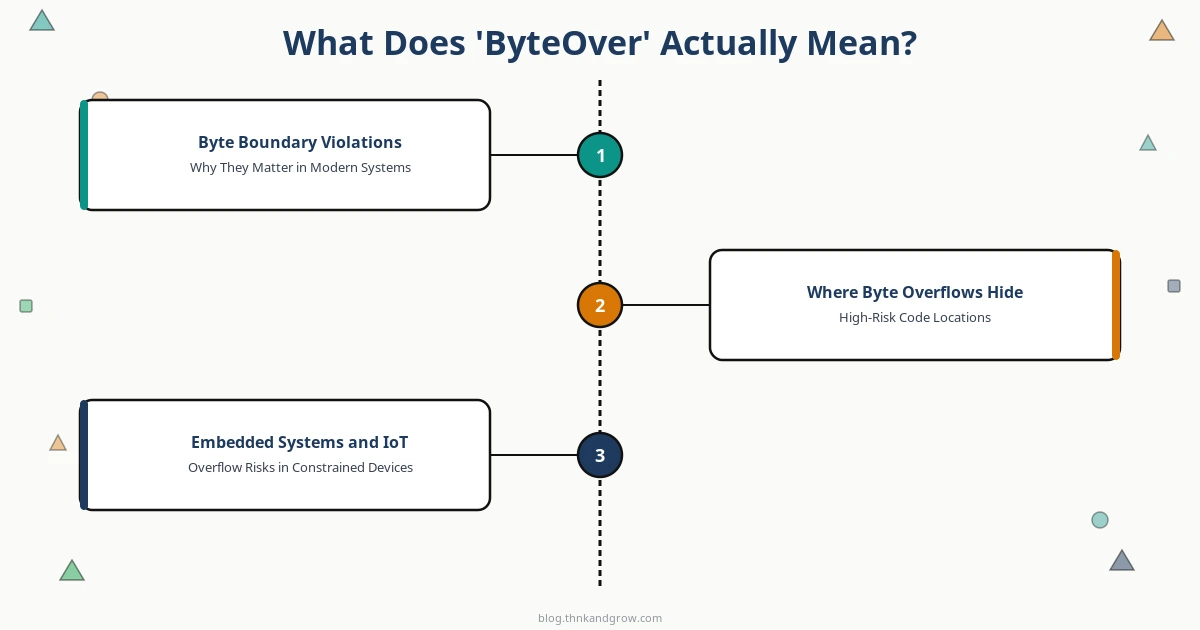
Where Byte Overflows Hide: High-Risk Domains
ByteOver conditions are not uniformly distributed across software. Certain domains carry disproportionately high risk due to the nature of their data handling, memory constraints, or performance requirements.
Embedded Systems and IoT
Microcontrollers — Arduino, STM32, ESP32 — operate with kilobytes of RAM. There is no virtual memory, no operating system memory manager, and often no hardware memory protection. A buffer overflow in firmware doesn't just crash the device; it can brick it permanently or create a remote code execution vector reachable over Wi-Fi or Bluetooth. UART, SPI, and I2C communication protocols are particularly vulnerable to byte overrun when incoming data arrives faster than the interrupt handler can drain the receive buffer.
Network Protocol Parsing
Parsing packet headers requires precise byte counting at every step. A single miscounted length field — as Heartbleed demonstrated — can expose arbitrary memory. In high-throughput scenarios, even a correctly implemented parser can experience byte overrun if the receive buffer is undersized relative to burst traffic. Network drivers in operating system kernels are especially sensitive because a single overflow can escalate directly to kernel-level code execution.
Image and Media Processing
Image parsing libraries are historically one of the richest targets for byte overflow exploits. Malformed JPEG, PNG, and GIF files can be crafted with incorrect dimension fields or chunk size values that cause the parser to allocate a small buffer but then write a large payload into it, triggering a heap overflow. This attack vector is particularly dangerous because image files are routinely accepted from untrusted sources — email attachments, web uploads, messaging apps.
Cryptographic Implementations
Off-by-one errors in cryptographic code carry outsized consequences. A single extra byte written into a key buffer can corrupt the key material, invalidate a signature, or — worse — leak sensitive data through a padding oracle. Block cipher implementations that handle padding manually are especially prone to these errors. The consequences are not just crashes; they are silent security failures that may go undetected for years.
Game Development
Multiplayer games present a rich attack surface through network packet deserialization. If a game client trusts packet length fields from the network without validation, a malicious server (or a man-in-the-middle) can send crafted packets that overflow the client's receive buffer. Save file parsing is another common vector — raw binary reads from untrusted save files without bounds checking have been exploited in multiple commercial titles.
Smart Contracts
The Solidity ecosystem learned its integer overflow lessons the hard way. Before version 0.8.0, developers had to manually use the SafeMath library to prevent overflows. Contracts that skipped this step were vulnerable to attacks where an attacker could cause a balance to wrap from near-zero to near-maximum by exploiting unsigned integer arithmetic. The lesson — that runtime overflow protection should be a language default, not an opt-in library — has since been incorporated into Solidity's design, but thousands of legacy contracts remain deployed with the old behavior.
The Modern Defense Stack: Tools and Languages
The good news is that the industry's defense stack against ByteOver conditions has never been stronger. The bad news is that adoption remains uneven.
Memory-Safe Languages
Rust eliminates most byte boundary violations at compile time through its ownership and borrowing model. You cannot have a dangling pointer or a buffer overread if the borrow checker rejects the code. Go provides runtime bounds checking on all slice and array accesses, panicking on out-of-bounds rather than silently corrupting memory. Zig takes a different approach with comptime overflow handling — you explicitly choose the overflow behavior (panic, wrap, saturate) at the call site, making the semantics visible and auditable.
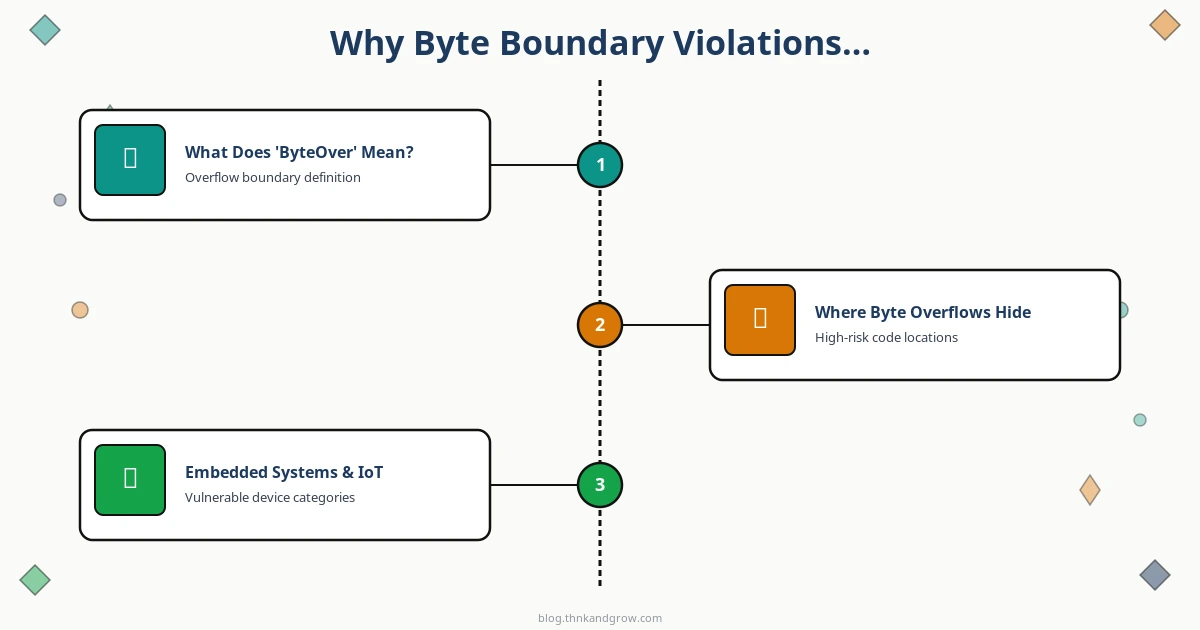
Runtime Detection Tools
AddressSanitizer (ASan) is a compiler instrumentation tool that detects out-of-bounds reads and writes, use-after-free, and stack buffer overflows at runtime with minimal false positives. It should be a standard part of every C/C++ development build. Valgrind Memcheck provides deeper heap analysis at the cost of significant runtime overhead, making it ideal for QA environments. Stack canaries (-fstack-protector-all) place a known sentinel value between local variables and the return address; if a stack overflow overwrites the canary, the program terminates before the corrupted return address is used.
Fuzzing Frameworks
AFL++ and libFuzzer are coverage-guided fuzzing frameworks that automatically generate malformed inputs to discover byte boundary bugs. Fuzzing is particularly effective for parsers — image decoders, protocol handlers, file format readers — because it exercises edge cases that unit tests rarely reach. Integrating fuzzing into CI/CD as a continuous background process (as Google does with OSS-Fuzz) dramatically reduces the time-to-discovery for these vulnerabilities.
Static Analysis in CI/CD
CodeQL, Coverity, Semgrep, and PVS-Studio can identify byte overflow patterns in source code before a single line is executed. CodeQL, in particular, supports dataflow analysis that can trace tainted input from an untrusted source through multiple function calls to an unsafe buffer write — the kind of multi-hop vulnerability that manual review frequently misses.
Hardware Mitigations
Modern hardware is increasingly providing architectural defenses. ARM Memory Tagging Extension (MTE) associates a tag with each memory allocation and checks that tag on every access, catching use-after-free and out-of-bounds accesses at the hardware level. Intel Control-flow Enforcement Technology (CET) uses shadow stacks to detect return address overwrites, directly countering the most common exploitation technique for stack buffer overflows. RISC-V Physical Memory Protection (PMP) enforces memory access permissions at the hardware level, critical for embedded systems without an MMU.
WebAssembly's Sandboxing Model
WebAssembly's linear memory model is a notable architectural response to ByteOver conditions. WASM programs operate within a sandboxed linear memory space that cannot access the host process's memory, even if an internal buffer overflow occurs. This doesn't eliminate the bug, but it dramatically limits the blast radius — a property that makes WASM an attractive compilation target for security-sensitive components.
Best Practices Every Developer Should Follow
Defense against ByteOver conditions operates across three phases: prevention, detection, and response.
Prevention
- Prefer memory-safe languages where performance constraints allow. If you're starting a new project, the default choice for systems programming should be Rust or Go, not C.
- Enable aggressive compiler warnings. In GCC/Clang, compile with
-Wall -Wextra -Werrorand treat warnings as errors. Many byte boundary bugs generate warnings that developers habitually ignore. - Use safe string and memory functions. Replace
strcpywithstrncpy,sprintfwithsnprintf, andgetswithfgets. Better yet, use C++std::stringor a bounds-checked string library. - Always perform bounds checking before buffer accesses. Never trust a length field from an external source — validate it against the actual allocated buffer size before using it to index or copy data.
- Validate and sanitize all external input. This is especially critical in parsers and protocol handlers. Treat every byte arriving from the network, a file, or user input as potentially malicious.
A minimal example of the difference between unsafe and safe buffer handling in C:
// ❌ Unsafe — trusts caller-provided length, no bounds check
void process_packet(char *buf, int len) {
    char local[64];
    memcpy(local, buf, len);  // len could be > 64
}

// ✅ Safe — validates length before copy
void process_packet(char *buf, int len) {
    char local[64];
    if (len < 0 || (size_t)len > sizeof(local)) {
        return;  // reject invalid input
    }
    memcpy(local, buf, (size_t)len);
}
Detection
- Run AddressSanitizer in all development and CI builds for C/C++ codebases. The overhead is acceptable in non-production environments and the signal-to-noise ratio is excellent.
- Use Valgrind Memcheck in QA environments for deeper heap analysis.
- Enable ASLR + PIE in production builds. Address Space Layout Randomization doesn't prevent overflows, but it dramatically complicates exploitation by randomizing the memory layout an attacker would need to predict.
- Integrate static analysis into your CI/CD pipeline as a non-negotiable gate. A pull request that introduces a new out-of-bounds write pattern should fail the pipeline automatically.
- Add continuous fuzzing for all input-parsing code paths. Even a few hours of fuzzing per day catches vulnerabilities that months of manual review miss.
Response
- Maintain a responsible disclosure process and publish CVEs promptly when byte boundary vulnerabilities are discovered in your software.
- Follow CVE patching SLAs — critical memory safety vulnerabilities (CVSS 9.0+) should be patched and deployed within days, not weeks.
- Conduct post-incident reviews that trace the root cause back to the specific byte boundary failure and update coding standards accordingly.
What's Changing in 2025: Trends to Watch
The industry is at an inflection point on memory safety, and ByteOver conditions are at the center of that shift.
Government and Regulatory Pressure
The NSA and CISA published guidance in 2023 explicitly recommending that organizations move away from C and C++ toward memory-safe languages.


