GitNexus: AI-Powered Code Review for GitHub PRs
Every engineering team eventually hits the same wall. Pull requests pile up, senior engineers become review bottlenecks, and the quality of feedback degrades as reviewer fatigue sets in. A quick scan replaces a thorough analysis, a “LGTM” ships code that deserves a harder look, and bugs that should have been caught in review end up as incidents in production. Manual code review at scale is genuinely hard — and it’s one of the most expensive invisible costs in modern software development.
This is the problem that GitNexus sets out to solve. Built by Abhigyan Patwari and hosted as an open-source project on GitHub, GitNexus is an AI-powered code review agent that automatically analyzes GitHub pull requests using a combination of large language models (LLMs), retrieval-augmented generation (RAG) pipelines, and a clean web dashboard. It’s not just another “pass your diff to GPT” wrapper — it’s a thoughtfully architected system that treats automated code review as a serious engineering problem worth solving properly.
In this post, we’ll walk through what GitNexus is, how its pipeline works under the hood, why RAG is the key differentiator, and how you can start using or contributing to it today.
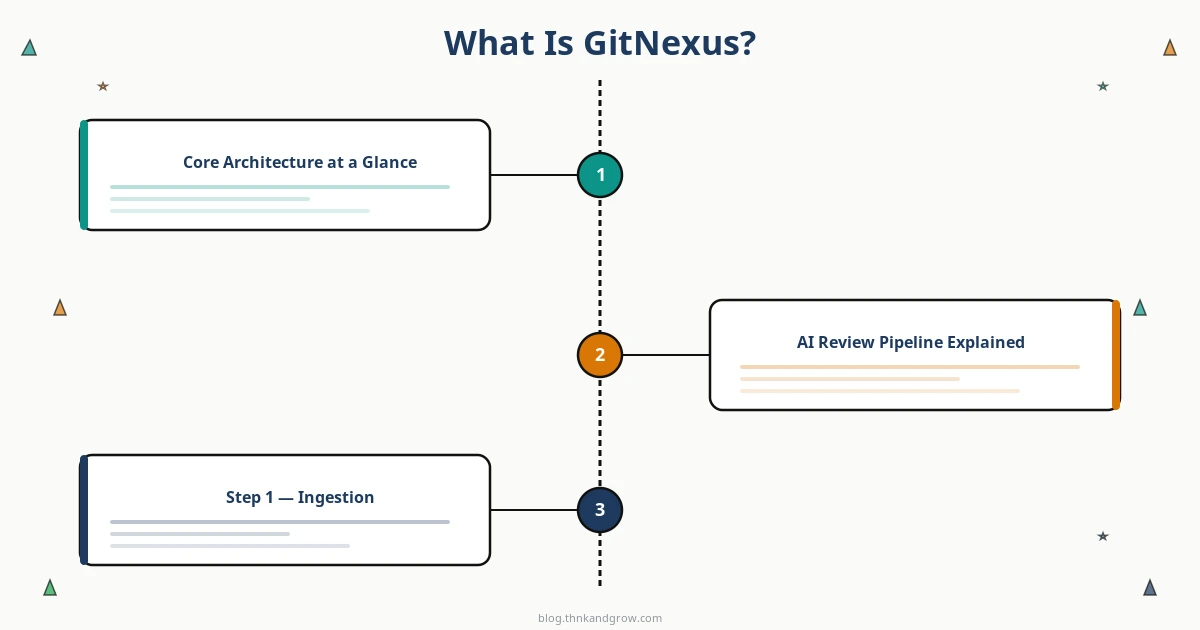
What Is GitNexus?
GitNexus is an open-source project that combines a Python backend, a Next.js web frontend, and an LLM-driven review engine into a cohesive system for automated GitHub PR analysis. The project lives at github.com/abhigyanpatwari/GitNexus and is designed to be self-hostable, extensible, and transparent about how its review decisions are made.
The core premise is simple but powerful: instead of asking a human engineer to hold an entire codebase in their head while reviewing a diff, GitNexus programmatically retrieves the relevant context, enriches the raw diff with it, and then asks a language model to produce structured, actionable review comments. The result is surfaced through a web dashboard that teams can use to browse, filter, and act on the AI-generated feedback.
What makes GitNexus worth paying attention to — beyond the novelty of the idea — is its architectural discipline. The project separates concerns cleanly, includes an evaluation harness for measuring review quality, and is built with the kind of modularity that makes it genuinely extensible rather than a one-off experiment.
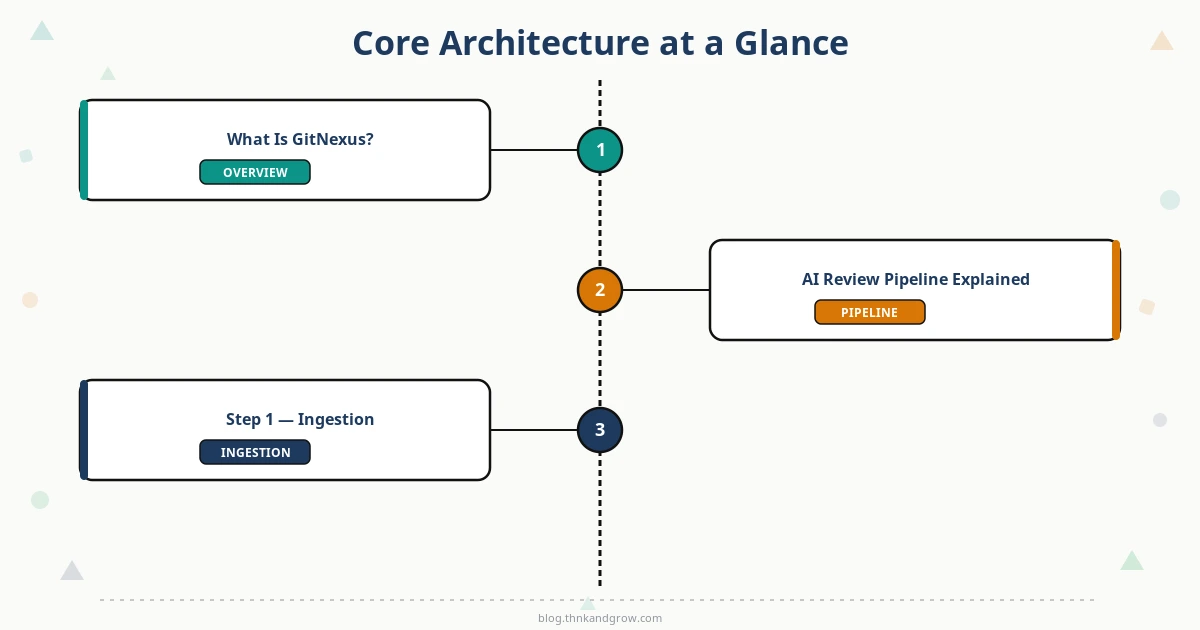
Core Architecture at a Glance
GitNexus is organized around four distinct layers, each with a clear responsibility:
- Ingestion Layer: A Python backend (built with FastAPI) that interfaces with the GitHub API to fetch PR diffs, file trees, commit metadata, and related repository information.
- Augmentation Layer: A RAG engine that enriches the raw diff data with broader repository context — related files, historical changes, and relevant code patterns — before anything is sent to an LLM.
- Inference Layer: The LLM integration that takes the enriched, context-grounded prompt and generates structured review comments covering bugs, code smells, style violations, and improvement suggestions.
- Presentation Layer: A Next.js frontend that renders the review results in a browsable, filterable dashboard, making the AI output actionable for developers and team leads.
This modular separation is not accidental. It means you can swap out the LLM provider, upgrade the augmentation strategy, or replace the frontend without touching the other layers. For a developer tooling project that expects to evolve quickly as the LLM ecosystem matures, this kind of architectural hygiene is genuinely valuable.
The AI Review Pipeline Explained
Let’s trace a pull request through the GitNexus pipeline from start to finish.
Step 1 — Ingestion
When you point GitNexus at a GitHub PR, the backend uses the GitHub API to pull down everything it needs: the raw diff (the actual line-by-line changes), the file tree of the affected repository, commit messages, and metadata like the PR description and labels. This raw material is the foundation of the review, but on its own it’s not enough — a diff without context is like reading a chapter from a book without knowing the plot.
Step 2 — Augmentation
This is where GitNexus does something most “AI code review” tools skip entirely. The augmentation engine uses RAG techniques to retrieve relevant context from the broader repository before the LLM ever sees the diff. This might include related files that the changed code interacts with, the history of the modified functions, or patterns established elsewhere in the codebase that the new code should conform to.
Concretely, this involves embedding code chunks, storing them in a vector index, and querying that index with the diff content to retrieve the most semantically relevant surrounding context. The result is a much richer prompt — one that gives the LLM the same kind of situational awareness a senior engineer would have after working in the codebase for months.
Step 3 — LLM Inference
The enriched context package is then sent to a language model with a structured prompt that asks for specific categories of feedback: potential bugs, performance issues, code smells, style violations, and suggestions for improvement. The model’s output is structured rather than free-form, which makes it easier to parse, display, and act on in the dashboard.
A simplified version of what the prompt construction looks like conceptually:
# Enriched prompt structure (conceptual)
system: "You are an expert code reviewer. Analyze the following PR diff
         in the context of the surrounding codebase. Return structured
         feedback covering: bugs, code smells, style issues, suggestions."

user: f"""
PR Diff:
{pr_diff}

Relevant Codebase Context (retrieved via RAG):
{augmented_context}

PR Description:
{pr_description}
"""
Step 4 — Evaluation
Here’s a feature that sets GitNexus apart from most similar tools: a built-in evaluation harness that measures the quality and consistency of the generated reviews. This allows maintainers (and contributors) to benchmark changes to the pipeline — a new prompt template, a different retrieval strategy, a new LLM provider — against a baseline, and quantify whether the reviews actually got better or worse. It’s the kind of engineering rigor you’d expect in an ML system but rarely see applied to developer tooling.
Key Features and Capabilities
Stepping back from the pipeline mechanics, here’s what GitNexus actually delivers as a product:
- Automated bug and code smell detection: The LLM analyzes diffs for common issues — null pointer risks, improper error handling, logic errors, naming inconsistencies — and flags them with line-level specificity.
- Context-aware suggestions: Because the augmentation layer grounds the model in real repo context, suggestions are relevant to the actual codebase rather than generic best-practice platitudes.
- Web dashboard: The Next.js frontend gives teams a dedicated UI to browse review comments, filter by severity or category, and track which issues have been addressed.
- Evaluation framework: The built-in eval harness enables continuous benchmarking of review quality — a capability that makes GitNexus a living system rather than a static tool.
Why RAG Makes Code Review Smarter
It’s worth dwelling on the RAG component, because it’s genuinely the differentiating factor between GitNexus and a naive “send the diff to ChatGPT” approach.
A plain LLM has no knowledge of your specific repository. It doesn’t know that your team has a convention for error handling in service classes, that a particular utility function exists and should be used instead of reimplementing its logic, or that the file being modified is a critical path component that requires extra scrutiny. Without this context, even a powerful model produces reviews that are generic, sometimes irrelevant, and occasionally just wrong — confidently suggesting changes that contradict established patterns in the codebase.
RAG solves this by making the model’s knowledge dynamic and repo-specific. Before inference, the augmentation engine retrieves the most relevant chunks of the codebase and injects them into the prompt. The model now has access to the same contextual knowledge a human reviewer would bring to the table. The practical effects are significant:
- Fewer hallucinations: The model is grounded in actual code rather than generating plausible-sounding but incorrect suggestions.
- More relevant feedback: Suggestions reference real patterns, real utilities, and real conventions from the codebase.
- Better scalability: In large repos, no human reviewer can hold all relevant context in working memory. RAG retrieval scales to codebases of any size.
This is the architectural bet that GitNexus makes, and it’s a well-reasoned one. As embedding models and vector retrieval improve, the quality of the augmentation step — and therefore the quality of the reviews — improves with them.
Getting Started with GitNexus
If you want to run GitNexus locally or deploy it for your team, the setup process is straightforward:
- Clone the repository:
git clone https://github.com/abhigyanpatwari/GitNexus.git - Configure credentials: Set your GitHub API token and your LLM provider API key (e.g., OpenAI) in the environment configuration. The backend uses these to fetch PR data and call the inference endpoint respectively.
- Start the Python backend: Install dependencies with
pip install -r requirements.txtand run the FastAPI server. This starts the ingestion, augmentation, and inference services. - Launch the Next.js frontend: Navigate to the web directory, run
npm install && npm run dev, and open the dashboard in your browser. - Trigger a review: Point GitNexus at a GitHub repository and a specific PR number. The pipeline runs automatically and results appear in the dashboard within minutes.
The project is designed to work with both public and private GitHub repositories, provided your API credentials have the appropriate access scopes.
Potential Use Cases and Limitations
GitNexus is particularly well-suited for a few specific scenarios:
- Solo developers who want automated feedback on their own PRs before merging — essentially a tireless, opinionated pair programmer.
- Small teams without dedicated senior reviewers, where AI-assisted review can catch issues that might otherwise slip through.
- Open-source maintainers managing high volumes of external contributions, where the time cost of reviewing every PR thoroughly is prohibitive.
That said, it’s important to be clear-eyed about the current limitations. LLM cost per review can add up on large PRs or high-volume repositories — each review involves multiple API calls with substantial token counts. Latency on large diffs is a real constraint; the augmentation and inference steps take time, and very large PRs can be slow to process. And like any LLM-based system, GitNexus will perform best on codebases that resemble its training data — domain-specific or highly specialized codebases may require fine-tuning or prompt customization to get the most relevant feedback.
Looking forward, the most exciting potential directions include native GitHub Actions integration (triggering reviews automatically on PR creation), support for multiple LLM providers to give teams cost and capability tradeoffs, and incremental diff reviews that only re-analyze changed portions of a PR rather than the full diff on every run.
Conclusion
GitNexus is a genuinely impressive open-source blueprint for what AI-assisted code review can look like when it’s built with architectural discipline. By combining a clean modular pipeline — ingestion, augmentation, inference, evaluation — with a RAG strategy that grounds the LLM in real repository context, it addresses the core failure mode of naive LLM-based review tools: the lack of codebase-specific knowledge that makes generic feedback useless in practice.
The built-in evaluation harness is a particularly noteworthy detail. It signals that this project is thinking about review quality as something to be measured and improved over time, not just shipped and forgotten. That’s the mindset of a serious engineering tool, not a demo.
Whether you’re a solo developer looking for an always-available reviewer, a team lead trying to reduce the review bottleneck, or an OSS maintainer drowning in incoming PRs, GitNexus offers a practical, extensible foundation worth exploring. And if you’re a developer interested in the intersection of LLMs, RAG pipelines, and developer tooling, the codebase itself is an excellent learning resource — a real-world application of retrieval-augmented generation to a concrete, high-value problem.
Head over to github.com/abhigyanpatwari/GitNexus, star the repo, and consider contributing. The future of software quality tooling runs through pipelines like this one, and the open-source community is exactly the right place to build it.


